Fuente: Willem Vandenameele


The ancient water fountain of Chimay, built over a spring of running water that flowed into the town, is a small building of brick and limestone dated by the inscription "consTRUIT EN 1827" on the limestone frieze.
The building has a three-arched portico, enclosed by a latticework and reinforced by two pillars at the corners. The interior has a brick dividing wall surmounted by a latticework. It has a slate gable roof with a hipped roof.
It is here that La légende des sept sauts was played:
In his book "Traditions de Wallonie" Jean Lefèvre writes: "In the region of Chimay and Couvin, a special dance, the seven-way dance, marks the end of the festival . The participants form a large circle and, to a special hum from the orchestra, they crouch suddenly down, shouting 'one jump', then getting up again (jumping slightly) and (p. 12) starting to dance again until the next signal, when they do two jumps. In total they make twenty-eight jumps they're exhausted...".
According to tradition, this dance originated in 1622 , when Chimay was besieged by the troops of Ernest Mansfeld. This general was an ally of the Protestant Netherlands, at war with the Archdukes Albert and Isabella, defenders of Catholicism and supported by the Prince of Chimay, Alexandre d'Arenberg.
The Chimacians resigned themselves to Mansfeld's cruelty. But this was without counting on the determination of the women , who were willing to pay personally: the bridges were lifted, the gates closed and barricaded, the streets filled with bulky goods... Taking the city would be difficult.
In their excitement, some soldiers noticed a sewer exit ; in fact, this pipe led to the fountain where the women came to wash their clothes ... When they knelt down, to their surprise they saw the head of the first soldier appear. Before he could utter a word, the washerwomen slit his throat ; the second suffered the same fate, then the third, and so on... The water turns color and becomes a pool of blood. The attackers understand. Mansfeld, furious, but in a hurry to return to the Netherlands, exclaims: "Addernest, we are abandoning you today, but we will be back...".
In the evening the people were relieved and danced in honor of the brave washerwomen. They organized a big round, mocking the "fools" who had ended up in the sewers.
They turned around, singing:
Tra la la la, la la la la lè-re
Tra la la la, la la la la la la la
Tra la la la, la la la la lè-re
Tra la la la, la la la la la la
On each final, you raise your arms, crouch and shout "un sot", or "1-2 sots", ... and so on until you reach "1-2-3-4-5-6-7 sots", then you get up and dance to the song.
Over time, the word "sot", forgetting its origin, became "saut", simply by phonetic change.
Fuente: Willem Vandenameele
 | | Pública | Alemán • Catalán • Danés • Español • Francés • Italiano • Neerlandés

Selecciona una de las actividades más populares a continuación o afina tu búsqueda
Descubre las rutas más bonitas y populares de la zona, cuidadosamente agrupadas y seleccionadas.
Fuente: Willem Vandenameele
Selecciona una de las categorías más populares a continuación o inspírate en nuestras selecciones
Descubre los lugares de interés más bonitos y populares de la zona, cuidadosamente agrupados y selecciondos.
Fuente: Willem Vandenameele
Con RouteYou, es fácil crear tus propios mapas personalizados. Simplemente traza tu ruta, agrega puntos de ruta o nodos, agrega lugares de interés, lugares para comer y beber, y luego compártelo fácilmente con tu familia y amigos.
Planificador de rutas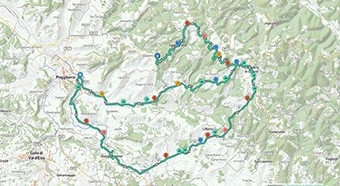
<iframe src="https://plugin.routeyou.com/poiviewer/free/?language=es&params.poi.id=8741262&params.language=en" width="100%" height="600" frameborder="0" allowfullscreen></iframe>

Más de 10.100.000 rutas

Más de 15.000.000 usuarios

Más de 4.500.000 lugares de interés

Kerkstraat 108
9050 Gentbrugge, Bélgica
Contacte con nuestro equipo de atención al cliente o visite nuestro centro de ayuda.
© 2006-2025 RouteYou - www.routeyou.com