The French Revolution Walk in Paris.

 
Need a hotel nearby?

The French Revolution Walk in Paris.

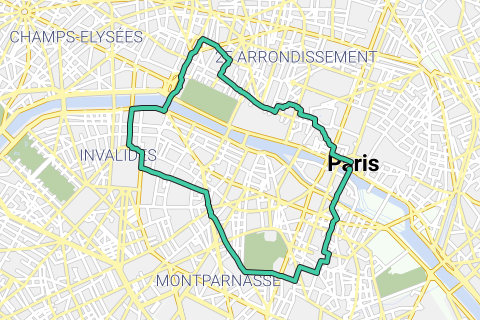
The French Revolution Walk in Paris is based and inspired by some major events, places and figures direclty or indirectly related to the French Revolution in Paris.

Sponsored links


Statistics

General difficulty level

General difficulty score: 70/100.

Easy Difficult

Difficulty level in detail

Total ascent: 151 m
Difficulty level (relative): 6/10

Max. slope (base 500m): 2.72 %
Difficulty level (relative): 7/10

Length: 9.99 km
Difficulty level (relative): 7/10

This route on your website

More info


Places of interest (along the route) (show all)

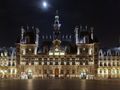
Hôtel de ville (distance from start: 0 km/0 miles)

Hôtel de ville
4ème Arrondissement Paris
In July 1794, the Hôtel de ville was a scene of violence. After a reign of terror lead by Robespierre, opponents tried to take power. Afraid to be captured the famous French Revolutionair Maximilien Robespierre Robespierre tried to kill himself with a pistol but only managed to shatter his jaw. Others, such as his brother Augusting, jumped out of the window of the Hôtel de ville.

They took Robespierre with shattered jaw to be executed. He was held in the same containment chamber where Marie Antoinette, the wife of King Louis XVI, had been held, before her execution.

On 28 July 1794, Robespierre was guillotined without trial in the Place de la Révolution.

Tour Saint-Jacques (distance from start: 0.2 km/0.12 miles)

Tour Saint-Jacques
4ème Arrondissement Paris
The Tour Saint-Jacques is the starting point for the chemin de Compostelle. From here, the road lead to Tours.

The Tour Saint-Jacques, a Gothic tower, is all that remains of the former church of Saint-Jacques-la-Boucherie.

A statue of Blaise Pascal is located at the base of the tower, commemorating the experiments on atmospheric pressure, though it is debated whether they were performed here or at the church of Saint-Jacques-du-Haut-Pas.

The tower inspired Alexandre Dumas to write the play La tour Saint-Jacques-la-boucherie in 1856.

Garden of Palais Royal (distance from start: 1.41 km/0.88 miles)

Garden of Palais Royal
1er Arrondissement Paris
The garden had irregular backs of houses that faced the surrounding streets. Most of these houses were shops. In one of these shops Charlotte Corday bought the knife she used to stab Jean-Paul Marat, a major event in the French Revolution. It became also famous by painting by David and Paul-Jacques-Aimé Baudry.

During the French revolutionary period, the gardens of the Palais-Royal were opened to all Parisians. Therefore, the palace was called Palais de l'Égalité.

Palais-Royal (distance from start: 1.61 km/1 miles)

Palais-Royal
1er Arrondissement Paris

The Palais-Royal was originally called the Palais-Cardinal, because it was the residence of Cardinal Richelieu. He asked architect Jacques Lemercier who also created the chapel at the Sorbonne.

Église Saint-Roch (distance from start: 2 km/1.24 miles)

Église Saint-Roch
1er Arrondissement Paris
Église Saint-Roch is a place where famous people were buried such as:
-Denis Diderot, philosopher and creator of the Encyclopédie
-Pierre Louis Maupertuis, Mathematician
-André Le Nôtre, French landscape architect and principal gardener of Palace of Versaille
-...

Hôtel Ritz (distance from start: 2.42 km/1.51 miles)

Hôtel Ritz
1er Arrondissement Paris
Hôtel Ritz was one of the favourite places of top Nazi Hermann Göring. Now the hotel wants to focus more on other famous people it had as guests. These include Ernest Hemingway, for whom a bar in the hotel was named, and F. Scott Fitzgerald, Marcel Proust, King Edward VII of the United Kingdom, Iranian leader Reza Shah, Rudolph Valentino, Charlie Chaplin, Greta Garbo, Marlene Dietrich, Maurice Chevalier, Jean-Paul Sartre, Elton John, plus couturier Coco Chanel who made the Ritz her home for more than thirty years.

Église de la Madeleine (distance from start: 3.09 km/1.92 miles)

Église de la Madeleine
8ème Arrondissement Paris
Église de la Madeleine was as a temple to the glory of Napoleon's army. The Madeleine is built in the Neo-Classical style and was inspired by the Maison Carrée at Nîmes, one of the best-preserved of all Roman temples.

The pediment sculptures shows the Last Judgment, by Henri Lemaire who also made the sculptures fo rthe Arc de Triomphe.

Place the la Révolution (distance from start: 3.69 km/2.29 miles)

Place the la Révolution
8ème Arrondissement Paris
Place the la Révolution is now known as Place de la Concorde.

On 28 July 1794, French Revolutionair Robespierre was guillotined here without trial together with his brother Augustin, Couthon, Saint-Just, Hanriot and twelve other followers, among them the cobbler Simon.
Only Robespierre was guillotined face-up.

Les Invalides (distance from start: 5.35 km/3.32 miles)

Les Invalides
7ème Arrondissement Paris
The most notable tomb at Les Invalides is that of Napoleon Bonaparte.

Rodin Museum (distance from start: 5.44 km/3.38 miles)

Rodin Museum
7ème Arrondissement Paris
Auguste Rodin used the Hôtel Biron as his residence. It is now the Musée Rodin showing famous works by him.

The Musée Rodin contains most of Rodin's significant creations, including The Thinker, The Kiss and The Gates of Hell.

The museum shows also works of Camille Claudel, Monet, Renoir and Van Gogh which were in Rodin's personal collections.

Hôtel Matignon (distance from start: 5.87 km/3.65 miles)

Hôtel Matignon
7ème Arrondissement Paris
The Hôtel Matignon is the official residence of the Prime Minister of France.

Hôtel Lutetia (distance from start: 6.48 km/4.03 miles)

Hôtel Lutetia
6ème Arrondissement Paris
Hôtel Lutetia is noted for its architecture and its historical role during the German occupation of France in World War II.

It is considered one of the first major Art Deco buildings in Paris.

When the war began in 1939, numerous refugees fled to Paris from conflict areas and places occupied by German forces. The Lutetia attempted to accommodate as many as possible. Later on, the hotel itself was requisitioned by the occupation forces, and used to house, feed, and entertain the officers in command of the occupation. After the end of the war, it was used as a repatriation center for prisoners of war, displaced persons, and returnees from the German concentration camps.

Famous guests over the years have included Pablo Picasso, Charles de Gaulle, André Gide, and Josephine Baker.

Jardin du Luxembourg (distance from start: 7.61 km/4.73 miles)

Jardin du Luxembourg
6ème Arrondissement Paris
The Jardin du Luxembourg is the garden of the French Senate, which is itself housed in the Luxembourg Palace. It is the largest public park of Paris.

In the southwest corner, there is an orchard of apple and pear trees and the théâtre des marionnettes (puppet theatre). The gardens include a large fenced-in playground for young children and their parents and a vintage carousel.

Saint-Jacques-du-Haut-Pas (distance from start: 8 km/4.97 miles)

Saint-Jacques-du-Haut-Pas
5ème Arrondissement Paris
Some state that the church of Saint-Jacques-du-Haut-Pas was used by scientist Blaise Pascal for his experiments on atmospheric pressure. Nevertheless, his satue is put at the Tour Saint-Jacques because most believe that was the location of the experiment.

Panthéon (distance from start: 8.82 km/5.48 miles)

Panthéon
5ème Arrondissement Paris
Under orders of the French President, Jacques Chirac, the body of Alexandre Dumas was exhumed from the cemetery at Villers-Cotterêts in Pacardie, and in a televised ceremony his new coffin flanked by four Republican Guards costumed as the Musketeers - Athos, Porthos, Aramis, and D'Artagnan was transported in a solemn procession to the Panthéon of Paris.

This is the great mausoleum where French luminaries are interred. Among those buried in its necropolis are Voltaire, Rousseau, Victor Hugo, Émile Zola, Jean Moulin, Marie Skłodowska-Curie, Louis Braille, Jean Jaurès and Soufflot, its architect.

Places of interest (near the route)

Hotels nearby

Practical locations nearby

Comments

Nothing found

Sponsored links