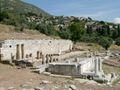
Messinia tour in honour of Luc Daels
Tour around the major landscapes and sites of Messinia in honour of geographer Prof. Luc Daels who introduced me to Greece.
It's a great tour in one of the nicest spots of Greece: the Peloponnese. It has a great variety in landscapes and interests. From and Ancient Tholos tomb to Frankish Castles used for slave trade, to the protected Osmananga Lagoon with all its fauna and flora.
Sponsored links
Statistics
This route on your website
Places of interest (along the route)
(show all)
Ancient Messini (distance from start: 17.47 km/10.86 miles)
Ancient Messini
The village of Messini was once a big and important Ancient city. The site was chosen by Epaminondas and lay on the western slope of the mountain which dominates the Messenian plain and culminates in the two peaks of Ithome and Eua. The former of these (740 m or 2,630 ft) served as the acropolis, and was included within the same system of fortifications as the lower city.
The strength of its ancient fortifications excelled all those of the Greek ancient world. Of the wall, some 5 miles (8 km) in extent, considerable portions yet remain, especially on the north and north-west, and almost the entire circuit can still be traced, affording the finest extant example of Greek fortification.
Odeon Theatre (distance from start: 17.47 km/10.86 miles)
Odeon Theatre
The Odeon theater of the ancient town of Messina.
Ancient Stadium of Messini (distance from start: 17.47 km/10.86 miles)
Ancient Stadium of Messini
The ancient stadium of Messini
Moni Voulkanou Monastery (distance from start: 19.74 km/12.26 miles)
Moni Voulkanou Monastery
The new Holy Monastery of Voulkano was founded in 1625 in the east part of Ithomi and was restored in 1967 by the Metropolitan Chrysostomos Themelis. In the centre of the yard there is the church in the shape of a domed cross.
The Holy Monastery is for men only and is celebrated on the 15th August.
On the 20th September the icon of the Blessed Virgin Mary is carried in a religious procession of 20 km, from the church of the Monastery of Voulcano to the church of the Source of Life in Messini in the area of Panigyristra where it is displayed for 9 days for people to pay their respects.
The Holy Monastery is for men only and is celebrated on the 15th August.
On the 20th September the icon of the Blessed Virgin Mary is carried in a religious procession of 20 km, from the church of the Monastery of Voulcano to the church of the Source of Life in Messini in the area of Panigyristra where it is displayed for 9 days for people to pay their respects.
Plain of Messinia (distance from start: 37.54 km/23.33 miles)
Plain of Messinia
The plain of Messinia is a graben system: a geological block which went down relative to the two blocks which went up (horsts). On the East side: the Taygetos Mountain Range, West the Kyparissia Mountains.
This graben was filled up with river and sea deposits (mainly clay) forming the vertile plain of Messinia. It's also here that the river Nedon found its way between the mountain ranges to the Gulf of Massinia.
Kalamata Railwaystation (distance from start: 43.27 km/26.88 miles)
Kalamata Railwaystation
Kalamata is connected to the railway lines of Greece. There are mainline train services to Kyparissia, Pyrgos, Patras and Kiato and suburban services to Messini and the General Hospital.
Railwaymuseum of Kalamata (distance from start: 43.27 km/26.88 miles)
Railwaymuseum of Kalamata
The railwaymuseum of Kalamata
Marina of Kalamta (distance from start: 43.27 km/26.88 miles)
Marina of Kalamta
The Marina and the Port of Kalamata, located SW of the city centre. It is the main and largest port in Messinia and the southern part of the Peloponnese.
Nedon River (distance from start: 43.27 km/26.88 miles)
Nedon River
Kalamata (distance from start: 43.27 km/26.88 miles)
Kalamata
Kalamata is renowned as the land of the Kalamatianos dance and the silk kerchief; of succulent dark olives, honey-eyed figs and the honey-covered sesame sweet called pasteli.
Kalamata has developed into a modern provincial capital, with all facilities and amenities, as well as one of the most modern hospitals in Greece.
There are numerous historical and cultural sights to see in Kalamata, such as the Villehardouin castle, the Ipapandis Byzantine church, the Kalograion monastery with its famous silk-weaving workshop where the beautiful Kalamata scarves are made, and the municipal railway park. Another great spot to visit is the church of Agion Apostolon where Mavromihalis declared the revolution. It’s also worth seeing the art collections housed at the Municipal Gallery, the Benaki Archaeological Museum and the Folk Art Museum.
From 1681 on the Venetians ruled Kalamata. In 23 March 1821, Kalamata was the first city to be liberated from the Turkish occupation of as much as over 300 years, by the Greek rebel forces under the orders of generals Theodoros Kolokotronis, Petros Mavromichalis and Papaflessas
Kalamata has developed into a modern provincial capital, with all facilities and amenities, as well as one of the most modern hospitals in Greece.
There are numerous historical and cultural sights to see in Kalamata, such as the Villehardouin castle, the Ipapandis Byzantine church, the Kalograion monastery with its famous silk-weaving workshop where the beautiful Kalamata scarves are made, and the municipal railway park. Another great spot to visit is the church of Agion Apostolon where Mavromihalis declared the revolution. It’s also worth seeing the art collections housed at the Municipal Gallery, the Benaki Archaeological Museum and the Folk Art Museum.
From 1681 on the Venetians ruled Kalamata. In 23 March 1821, Kalamata was the first city to be liberated from the Turkish occupation of as much as over 300 years, by the Greek rebel forces under the orders of generals Theodoros Kolokotronis, Petros Mavromichalis and Papaflessas
Bridge - Nedon River (distance from start: 43.27 km/26.88 miles)
Bridge - Nedon River
Bridge over the Nedon River.
Airport of Kalamata (distance from start: 47.77 km/29.68 miles)
Airport of Kalamata
Kalamata International Airport mainly receives charter flights during the summer months. The runway is about 2 km long and runs from north to south from the highway north to the plain.
Messini (distance from start: 48.3 km/30.01 miles)
Messini
The modern village of Messini should not be confused with the Ancient Messini, located more tto the north.
Nea Karoni (distance from start: 76.34 km/47.44 miles)
Nea Karoni
Neo Karoni, the 'New Koroni' is obviously a very new village. If you look at the groundplan of the village, you can see it is very specific and ordered structure.
Koroni (distance from start: 85.9 km/53.38 miles)
Koroni
Koroni with its Venetian castle.
Southern extensions of the Mountains of Lykodymon (distance from start: 94.12 km/58.48 miles)
Southern extensions of the Mountains of Lykodymon
Finikounda Beach (distance from start: 105.07 km/65.29 miles)
Finikounda Beach
Finikounda Beach is a beacu in a nice bay.
Disected plateau of Evangelismos (distance from start: 106.88 km/66.41 miles)
Disected plateau of Evangelismos
The disected plateau of Evangelismos is built up of marl and flysch. The marl was deposied in a calm and shallow sea on top of the flysch. The flysch was deposited durings a stong erosion phase when mountains were rising in this area.
Islet of Bomba (distance from start: 111.32 km/69.17 miles)
Islet of Bomba
The islet of Bomba, where according to legend the Apostle Paul landed when his ship sailed into a storm on its way to Rome. The bottom of the bay is strewn with shipwrecks.
The Oinnousai Pit (distance from start: 111.32 km/69.17 miles)
The Oinnousai Pit
The Oinnousai Pit is an underwater abyss that reaches to the deapest part of the Mediterranean, at 5.121 m.
Here the "NESTOR" experiment is cunducted and has to to with neutrinos and the past of the universe.
Data, including signals are being transmitted to the shore station in Methoni via a 30 km electro-optical cable laid on the sea-bed. This is the first time that continuous, real-time "physics" data have been obtained from such a depth, and represents a major step towards a kilometre cube neutrino detector.
The NESTOR (Neutrino Extended Submarine Telescope with Oceanographic Research) will ultimately consist of a tower with 12 floors of 32 m diameter.
Here the "NESTOR" experiment is cunducted and has to to with neutrinos and the past of the universe.
Data, including signals are being transmitted to the shore station in Methoni via a 30 km electro-optical cable laid on the sea-bed. This is the first time that continuous, real-time "physics" data have been obtained from such a depth, and represents a major step towards a kilometre cube neutrino detector.
The NESTOR (Neutrino Extended Submarine Telescope with Oceanographic Research) will ultimately consist of a tower with 12 floors of 32 m diameter.
Ammos Beach (distance from start: 111.58 km/69.33 miles)
Ammos Beach
There is only one sandy beach on the island but is a real gem. This beach is located on the north part of the island, facing Methoni and is called Ammos. It is protected by the northwestern winds and has a basic docking area and a wooden gazeebo where one can rest.
Strawberry Tree Forest of Sapienza (distance from start: 111.58 km/69.33 miles)
Strawberry Tree Forest of Sapienza
The mountains form a natural fort around the protected valley where the only Mediterranean Strawberry Tree Forest is located. It is comprised of trees, not bushes, with a height that is well over 10–12 m., which develop so much due to its isolation as well as the climatological conditions in the past 10.000 years. The forest and surrounding area of 24 hectars has been declared a natural preserve monument since 1986
Sapientza (distance from start: 111.58 km/69.33 miles)
Sapientza
Sapientza is an island south of Methoni with rocky areas and ending in forests and ravines rich in strawberry trees (Arbutus Unedo). It contains a lost monastery and Manetta's cave. An part of the area covering 240 acres has been announced "Natural Preserve Monument" by the state.
The populations is estimated to be about 700 animals, (400 sheep and 300 chamoes).
With the Sapientza Treaty in 1209 the island passed in the hands of the Venetians. It has been used as a docking area for the Turks and the Venetians during the third Venetian-Turkish war, and as a base of operations for the Greek fleet in 1825.
The ships that usually sailed near the coast of the island frequently crashed on its rocky coast resulting in the discovery of many important shiprwrecks from all the historical periods.
One of these sank at the north part of Sapientza with its stolen cargo which was the pillars from the Grand Peristyle built by Herod in Caissareia, Palestine, in the 1st century A.D.
Sapientza is a low island with an area of 9 square kilometres, its highest peak being on its north part, Foveri, at a height of 219 m. The slopes of the island climb up in lush greenery, and the crlystal clear waters of the sea, have a unique exotic colour.
The island Sapientz and its neighbouring islands Schiza, Santa Marina belong to the Oinoussai complex.
The populations is estimated to be about 700 animals, (400 sheep and 300 chamoes).
With the Sapientza Treaty in 1209 the island passed in the hands of the Venetians. It has been used as a docking area for the Turks and the Venetians during the third Venetian-Turkish war, and as a base of operations for the Greek fleet in 1825.
The ships that usually sailed near the coast of the island frequently crashed on its rocky coast resulting in the discovery of many important shiprwrecks from all the historical periods.
One of these sank at the north part of Sapientza with its stolen cargo which was the pillars from the Grand Peristyle built by Herod in Caissareia, Palestine, in the 1st century A.D.
Sapientza is a low island with an area of 9 square kilometres, its highest peak being on its north part, Foveri, at a height of 219 m. The slopes of the island climb up in lush greenery, and the crlystal clear waters of the sea, have a unique exotic colour.
The island Sapientz and its neighbouring islands Schiza, Santa Marina belong to the Oinoussai complex.
Foveri (distance from start: 111.58 km/69.33 miles)
Foveri
Sapientza highest peak is Foveri, with a height of 219 m. The slopes of the island climb up in lush greenery, and the crlystal clear waters of the sea, have a unique exotic colour.
Bay of Methoni (distance from start: 115.11 km/71.52 miles)
Bay of Methoni
Bay of Methoni
Bourtzi (distance from start: 115.5 km/71.77 miles)
Bourtzi
The Bourtzi is dated back to the period after 1500 and has been used in various instances as a prison. It has a two-floor octagonal tower. The tower finishes in a round dome. On the lower floor there was a cistern and the whole works, with small defensive value, and is dated during the first period that the Turks occupied the fortress.
When the winter winds hit its walls the locals say that you can hear the screams of the prisoners and the unjustly killed in the Bourtzi.
Fortress of Methoni (distance from start: 115.56 km/71.8 miles)
Fortress of Methoni
The town is also known by the Italian name Modon, as it was called by the Venetians. The Venetians fortified Methoni, which developed into an important trade center with great prosperity. Methoni became the important middle station between Venice and the Holy Lands, where every traveler stopped on their way to the East. A pilgrim who went by in 1484 admired its strong walls, the deep moats and the fortified towers.
The castle of Methoni occupies the whole area of the cape and the southwestern coast to the small islet that has also been fortified with an octagonal tower and is protected by the sea on its three sides. It's north part, the one that looks to land, is covered by a heavily fortified acropolis. A deep moat separates the castle from the land and communication was achieved by a wooden bridge. The Venetians built on the ancient battlements and added on and repaired it during both periods that they occupied the castle.
Methoni (distance from start: 115.56 km/71.8 miles)
Methoni
Methoni has been identified as the city Pedasus, that Homer mentions under the name "ampeloessa" (of vine leaves), as the last of the seven "evnaiomena ptoliethra", that Agamemnon offers Achilles in order to subdue his rage. Pausanias named the city Methoni, named after either the daughter of Oineas or a small islet.
Source: Wikipedia
Source: Wikipedia
Sarchophagi shipwreck (distance from start: 115.65 km/71.86 miles)
Sarchophagi shipwreck
Located in the northwest of the island Sapienza, is the Sarchophagi shipwreck. The shipwrecks around Sapientza are so numerous and important that there is a thought for the creation of an underwater archaeological park.
Valley of Methoni (distance from start: 116.68 km/72.5 miles)
Valley of Methoni
Limestone horst of Kynigos (distance from start: 131.77 km/81.88 miles)
Limestone horst of Kynigos
The Limestone horst of Kynigos sticks out above the lower lying marl plateau surrounding it. The village of Kynigos sits in the middle of the horst.
Lykodymon Mountains (distance from start: 136.41 km/84.76 miles)
Lykodymon Mountains
The Lykodymon Mountains stick out 900 m above sealevel. It sharply rises from the shores of the Messinia Peninsula towards the west.
Battle of Navarino (distance from start: 144.46 km/89.76 miles)
Battle of Navarino
The naval Battle of Navarino was fought here on 20 October 1827, during the Greek War of Independence (1821–32) in Navarino Bay. A combined Ottoman and Egyptian armada was destroyed by a combined British, French and Russian naval force. It is notable for being the last major naval battle in history to be fought entirely with sailing ships. The Allied ships were better armed than their Egyptian and Ottoman opponents and their crews were better trained, contributing to a complete victory.
Source: Wikipedia
Source: Wikipedia
Sphacteria island (distance from start: 145.32 km/90.3 miles)
Sphacteria island
Sphacteria is a small island at the entrance to the bay of Pylos.
In ancient times it was the site of the Battle of Sphacteria in the Peloponnesian war.
In 425BC, during the Peloponnesian War, the Athenians defeated the Spartans in a “commando” raid on Sphacteria Island.
In modern times the bay was the site of the Battle of Navarino in the Greek War of Independence from the Ottoman Empire (the forerunner to modern-day Turkey). In 1826 approximately 200 Greek fighters were blockaded there by Ibrahim Pasha's fleet when captain Tsamados set out a daring plan to rescue them. In August 1826 in a stormy night he slipped unnoticed with his ship "Ares" between the Turkish fleet and the castle of Navarino (controlled by Turkish forces then) to the island of Sphacteria and boarded the 200 fighters. While leaving he was noticed by the Turkish sailors and he was trapped between the fleet of 15 frigates and the castle cannons. The battle lasted for 2 hours but they managed to escape. Captain Tsamados, General Santaroza and the Secretary of Interior Anagnostaras were killed in action.
Source: Wikipedia
In ancient times it was the site of the Battle of Sphacteria in the Peloponnesian war.
In 425BC, during the Peloponnesian War, the Athenians defeated the Spartans in a “commando” raid on Sphacteria Island.
In modern times the bay was the site of the Battle of Navarino in the Greek War of Independence from the Ottoman Empire (the forerunner to modern-day Turkey). In 1826 approximately 200 Greek fighters were blockaded there by Ibrahim Pasha's fleet when captain Tsamados set out a daring plan to rescue them. In August 1826 in a stormy night he slipped unnoticed with his ship "Ares" between the Turkish fleet and the castle of Navarino (controlled by Turkish forces then) to the island of Sphacteria and boarded the 200 fighters. While leaving he was noticed by the Turkish sailors and he was trapped between the fleet of 15 frigates and the castle cannons. The battle lasted for 2 hours but they managed to escape. Captain Tsamados, General Santaroza and the Secretary of Interior Anagnostaras were killed in action.
Source: Wikipedia
Neokastro (distance from start: 145.32 km/90.3 miles)
Neokastro
The Neokastro, built on the rocks, at the south entrance of the harbor, began its construction in 1572 by the Turks. The visitor can see the Acropolis of the castle, the Temple of Metamorphosis Sotiros and the collection of the French Rene Paux,a philellenist, which is at the left of the today’s entrance of the castle, a building made of stone, known as the command post of Maizon. In the five years between 1982-1987, Niokastro was renovated throughout its entire area and came into operation, inside the castle, the Hellenic Center for Underwater Archeology of Pylos.
In the castle there was no water and works had to be made that would ensure the continued water provision of the castle. Tanks were built into the castle and two reservoirs that were meeting at the Kamares place and providing water to the fort through pipelines were placed. Apart from the Kamares, there are parts of aqueducts in the region of Cheimarou Xeria and in Ag.Constantine, near the village Handrinos, all, on the way to Kalamata.
Entrance to Navarinoo Bay (distance from start: 145.39 km/90.34 miles)
Entrance to Navarinoo Bay
Entrance to the Bay of Navarino
New Harbour of Pylos (distance from start: 145.82 km/90.61 miles)
New Harbour of Pylos
A new harbour of Pylos is built on the NE side of the town.
Old oilrefining factory of Gialova (distance from start: 150.78 km/93.69 miles)
Old oilrefining factory of Gialova
In the 1970’s there was an attempt to make Navarino Bay, the best anchorage in Greece, a major centre for oil refining. But pressure from international conservation bodies, and the demise of the “Colonels” put paid to the scheme. It did, however, leave some very ugly buildings around Gialova
Osmananga lagoon or Divari (distance from start: 154.49 km/96 miles)
Osmananga lagoon or Divari
The Osmananga lagoon is interesting both in an ecological and an archaeological manner. The area of 6000 acres is an important bird migratory location and hosts the Caretta-Caretta turtle and the African Chamaileonta. Perhaps the most intriguing aspect of the wildlife is the presence of chameleons. Recently it became known that they were of the African species and people have been at a loss to explain how they came to the Peloponnese. The explanation which seems to be most popular at the moment is that they are derived from pets which escaped from Roman villas!
Paleokastro of Pylos (distance from start: 155.05 km/96.34 miles)
Paleokastro of Pylos
The Palaiokastro was founded by the Franks in the 12th century who ruled the area till the Turks came in 1452. It is a stiff, and very sweaty, walk from the beach, past Nestor's Cave to the ramparts of the Kastro.
The Paleokastro (The Old Castle) offers the majestic views of the Ionian Sea and Voidokilia. The Paliokastro played an important role in all the events that took place in Pylos, but after the enclosing of the pass of Sykia by the Turks, played a minimal role because than started the building of Niokastro in the south of the harbor.
Pass of Sykia (distance from start: 155.05 km/96.34 miles)
Pass of Sykia
The Turks enclosed this pass of Sykia.
Plateau of Elayofyton (distance from start: 162.75 km/101.13 miles)
Plateau of Elayofyton
The Plateau of Elayofyton (with in its center the small and typical village of Elayofyton) is a sea of olive groves.
Graben of Vlachopoulo (distance from start: 171.51 km/106.57 miles)
Graben of Vlachopoulo
This block of land of Vlachopoulo shifted relatively down versus two other blocks, called a graben.
A graben is a depressed block of land bordered by parallel faults. Graben is German for ditch.
A graben is the result of a block of land being downthrown producing a valley with a distinct scarp on each side. Grabens often occur side-by-side with horsts.
This area also belongs to a plateau area of marl.
A graben is a depressed block of land bordered by parallel faults. Graben is German for ditch.
A graben is the result of a block of land being downthrown producing a valley with a distinct scarp on each side. Grabens often occur side-by-side with horsts.
This area also belongs to a plateau area of marl.
Kyparissia Mountains (distance from start: 177.45 km/110.26 miles)
Kyparissia Mountains
Tholos Tomb (distance from start: 179.35 km/111.44 miles)
Tholos Tomb
A beehive tomb, also known as the tholos tomb is a burial structure characterised by its false dome created by the superposition of successively smaller rings of mudbricks or, more often, stones. The resulting structure resembles a beehive. Tholoi were used for burial in several cultures in the Mediterranean and West Asia.
Ancien Palace of King Nestor (distance from start: 180.14 km/111.93 miles)
Ancien Palace of King Nestor
Close to the village Chora (which means 'village') is the famous Palace of King Nestor.
The palace of Nestoras was discovered in 1939. It is a piece of work dating back to the 13th century B.C. It consists of five main buildings which take up such a large area that it can only be compared, to the palaces of Mycaenae and Tiryntha.
The Palace of Nestor, on the Epano Englianos ridge was excavated from 1952 to 1966 by the late Professor Carl Blegen of the University of Cincinnati. The palace, dating from ca. 1300-1200 BC, is among the best preserved of Bronze Age complexes in Greece. In addition to architecture, excavations uncovered wall and floor frescos, Linear B tablets (the first ever discovered on the mainland!), sealings, jewelry, pottery and other artifacts.
The palace of Nestoras was discovered in 1939. It is a piece of work dating back to the 13th century B.C. It consists of five main buildings which take up such a large area that it can only be compared, to the palaces of Mycaenae and Tiryntha.
The Palace of Nestor, on the Epano Englianos ridge was excavated from 1952 to 1966 by the late Professor Carl Blegen of the University of Cincinnati. The palace, dating from ca. 1300-1200 BC, is among the best preserved of Bronze Age complexes in Greece. In addition to architecture, excavations uncovered wall and floor frescos, Linear B tablets (the first ever discovered on the mainland!), sealings, jewelry, pottery and other artifacts.
Gargaliani horst (distance from start: 181.32 km/112.67 miles)
Gargaliani horst
The Gargaliani horst stick out above the neighbouring land. A horst is the raised fault block bounded by normal faults or graben.
Voidokilia (distance from start: 191.69 km/119.11 miles)
Voidokilia
VOIDOKILIA is one of the most beautiful beaches in Greece. The sheltered bay is referred to in Homer's Odyssey and archaeologists believe it was used by King Nestor as a port in ancient times.
The name Voidokilia means "cow's belly", from the two rocky promontories that define the entrance of it. The beach lies beneath the Old Frankish castle (Paliokastro) and the cave of King Nestor, the ancient King of Pylos, who according to legend, used this cave as a haven for his cattle.
The lagoon is caused by currents in Navarino Bay transporting sediment along the coast and forming a sand spit from Gialova to the Palaiokastro island, cutting off part of the bay to form the Osmanaga lagoon. It was probably at this time that sand transported into Voidikilia Bay, was laid down and began to form the magnificent beach and sand dunes.
The name Voidokilia means "cow's belly", from the two rocky promontories that define the entrance of it. The beach lies beneath the Old Frankish castle (Paliokastro) and the cave of King Nestor, the ancient King of Pylos, who according to legend, used this cave as a haven for his cattle.
The lagoon is caused by currents in Navarino Bay transporting sediment along the coast and forming a sand spit from Gialova to the Palaiokastro island, cutting off part of the bay to form the Osmanaga lagoon. It was probably at this time that sand transported into Voidikilia Bay, was laid down and began to form the magnificent beach and sand dunes.
Cave of King Nestor (distance from start: 191.69 km/119.11 miles)
Cave of King Nestor
The cave of King Nestor, the ancient King of Pylos, who according to legend, used this cave as a haven for his cattle.
Places of interest (near the route)
Hotels nearby
Practical locations nearby
Comments
Nothing found