Wambeek was first mentioned in 877 as Wambacem. It was part of the domain of Nivelles, first in the province of Brabant, later in the duchy of Brabant. Most likely, Wambeek, along with Lennik and Gooik, belonged to the abbey of Nivelles since its foundation in the 7th century, during the time of the Merovingians. Because the abbesses wanted to prove their ownership rights against encroaching worldly rulers, Wambeek is mentioned in several early royal and imperial charters. In 1003, the emperor appointed the count of Leuven as protector of the abbey of Nivelles with the domain Lennik-Wambeek-Gooik. Thus, Wambeek is part of the oldest western territorial expansion of the counts of Leuven. In the 12th century, the lords of Wezemaal, vassals of the duke, seized all wastelands and forests, to the detriment of the abbey of Nivelles. At that time, Ternat and Sint-Katherina-Lombeek were still hamlets of Wambeek. Until the mid-14th century, the lordship of Wambeek extended over an area ranging from Sint-Katherina-Lombeek in the west to Ganshoren and Anderlecht in the east. Then the lordship of Wambeek was annexed to that of (Sint-Genesius-)Rode. This means that Wambeek, Ternat, and Sint-Katherina-Lombeek were not judicially connected to the Land of Gaasbeek or that of Asse during the time of the duchy. Although the hamlet of Ternat, due to the power expansion of the lords of Kruikenburg, already had more inhabitants than Wambeek itself from the 14th century and became larger in area, Wambeek still remained the seat of the court of the lordship for a long time. Ecclesiastically, Wambeek remained under the diocese of Cambrai until 1559. From the 11th century, it was part of the deanery of Halle in the Archdeaconry of Brabant. The Our Lady parish, later Sint-Gertrudis parish of Ternat, remained subordinate to the Sint-Remigius church of Wambeek for a long time. Archbishop Remigius baptized the Merovingian Chlodovech or Clovis in 506 in Reims. After the abolition of the lordship of Kruikenburg, in the Quarter of Brussels, by the French at the end of the 18th century, Wambeek became a separate municipality, which merged with Ternat and Sint-Katherina-Lombeek in 1976.
Bron: Wikipedia
Auteursrechten: Creative Commons
 | | Publiek | Deens • Duits • Frans • Italiaans • Nederlands • Spaans
Adres: Wambeek
Statistieken
Selecteer hieronder één van de populairste activiteiten of verfijn je zoekopdracht.
Ontdek de mooiste en meest populaire routes in de buurt, zorgvuldig gebundeld in passende selecties.
Selecteer hieronder één van de populairste categorieën of laat je inspireren door onze selecties.
Ontdek de mooiste en meest populaire bezienswaardigheden in de buurt, zorgvuldig gebundeld in passende selecties.
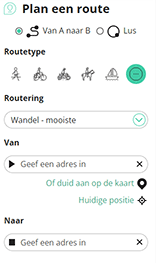
Met RouteYou kan je eenvoudig zelf aangepaste kaarten maken. Stippel je route uit, voeg waypoints of knooppunten toe, plan bezienswaardigheden en eet- en drinkgelegenheden in en deel alles met je familie en vrienden.
Routeplanner
<iframe src="https://plugin.routeyou.com/poiviewer/free/?language=nl&params.poi.id=11011&params.language=en" width="100%" height="600" frameborder="0" allowfullscreen></iframe>

Meer dan 11.800.000 routes

Meer dan 15.000.000 gebruikers

Meer dan 4.500.000 trekpleisters

Kerkstraat 108
9050 Gentbrugge, België
© 2006-2026 RouteYou - www.routeyou.com