The uranium content at Shinkolobwe was exceptionally high due to a highly efficient concentration process in favorable geological conditions; the site was even called a "freak occurrence" because such rich ore deposits have not been observed anywhere else.
But what are the geological conditions to get such a location?
Large uranium deposits typically form in old, stable continental regions (shields and cratons) where rocks have not been deeply buried or strongly shifted for tens to hundreds of millions of years.
Sufficient uranium must be present in the parent or source material. This uranium is released through the weathering of uranium-rich rocks, often granites.
Water (often oxygen-rich groundwater) transports dissolved uranium (usually in a hexavalent form, which is highly soluble). When chemical or physical conditions change (e.g., through reduction, interaction with organic material, or sulfides), uranium precipitates as insoluble minerals (often in a tetravalent form). This creates concentrated deposits, sometimes with very high uranium content.
A porous host rock (such as sandstone or fault zones) and sufficient water flow are crucial for both transport and subsequent precipitation.
 | | Pública | Neerlandés

Selecciona una de las actividades más populares a continuación o afina tu búsqueda
Descubre las rutas más bonitas y populares de la zona, cuidadosamente agrupadas y seleccionadas.
Selecciona una de las categorías más populares a continuación o inspírate en nuestras selecciones
Descubre los lugares de interés más bonitos y populares de la zona, cuidadosamente agrupados y selecciondos.
Con RouteYou, es fácil crear tus propios mapas personalizados. Simplemente traza tu ruta, agrega puntos de ruta o nodos, agrega lugares de interés, lugares para comer y beber, y luego compártelo fácilmente con tu familia y amigos.
Planificador de rutas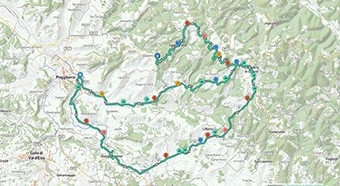
<iframe src="https://plugin.routeyou.com/poiviewer/free/?language=es&params.poi.id=9263013&params.language=en" width="100%" height="600" frameborder="0" allowfullscreen></iframe>

Más de 11.800.000 rutas

Más de 15.000.000 usuarios

Más de 4.500.000 lugares de interés

Kerkstraat 108
9050 Gentbrugge, Bélgica
© 2006-2026 RouteYou - www.routeyou.com