Datenquelle: Groenehartstocht
Around 1650, Cornelis de Graeff, the then mayor of Amsterdam, had a country house built on the road between Baarn and Soest: the Hofstede aen Zoestdijck. In 1674, De Graeff's son Jacob sold the Hofstede Soestdijk to his childhood friend, stadtholder Willem III. The Hofstede was presumably expanded into a hunting lodge between 1674 and 1678 on the orders of Willem III, designed by Maurits Post, son of Pieter Post. When Willem III and Queen Mary acquired the estate Het Oude Loo in 1684, the couple had a new hunting lodge built there. As a result, Soestdijk was not used as frequently.
In 1702, the Frisian stadtholder Johan Willem Friso inherited Soestdijk because Willem III died without children. After Johan Willem Friso's death in 1711, his wife and son, the later stadtholder Willem IV, spent summers at Soestdijk. Willem IV died in 1751, and his wife and son continued to live at Soestdijk during the summer. The estate outside Eult, across the Amsterdamse Straatweg, now the Baarnse Bos, was sold by the heirs of Willem Gideon Deutz on July 17, 1758, for 319,000 guilders to Princess-Governor Anna of Hannover.
In 1787, a scuffle occurred at Soestdijk between patriots and supporters of the House of Orange, resulting in one death and several injuries. The Utrecht States rewarded the officers on duty with a special gold or silver medal.
During the French War, Palace Soestdijk was seized by the patriots as war booty in 1795. In 1799, it was sold and designated as lodging. Louis Bonaparte, the brother of French Emperor Napoleon, took possession of it in 1806 and had a new extension built onto the palace. He used it until 1810.
After liberation, the palace was expanded with two wings on either side of the main building featuring characteristic semi-circular colonnades: the Soester wing on the left when viewed from the street, and the Baarnse wing on the right side. The palace was summer residence for Willem II and his wife Anna Paulowna, who redecorated it. After her death in 1865, it passed to Prince Henry, brother of King Willem III. He was stadtholder of Luxembourg but used Soestdijk as a Dutch pied-à-terre.
Queen mother Emma used Palace Soestdijk as a summer residence until her death in 1934. Some minor renovations were made, such as the installation of electrical wiring. Additionally, two dressing rooms were added on the first floor of the main building.
After the death of Queen mother Emma, the palace was remodeled to serve as a residence for Princess Juliana and Prince Bernhard. The extensive renovation was particularly focused on the Baarnse wing. A largely underground cinema was constructed for Prince Bernhard, and a large kitchen was added in the basement. On the ground floor, offices for Juliana and Bernhard, a dining room, a library, and a gym were created. Additionally, four guest apartments were added. The first floor was expanded with bedrooms, bathrooms, and dressing rooms for Juliana and Bernhard and their children. Rooms for the staff were also created.
In 1937, Princess Juliana and Prince Bernhard moved into the palace. For the first time in its history, it became the home of a young family. All princesses, except for Princess Margriet, were born at Soestdijk. Although Juliana officially carried out her duties as queen at Huis Ten Bosch in The Hague, in practice, this happened very little; the royal family primarily used Soestdijk and Palace Het Loo during Juliana's reign. Palace Soestdijk was officially designated as the main residence of the head of state in 1948, and Palace Het Loo became a country retreat, where Princess Wilhelmina moved in. To serve as a working palace, the secretariats of Juliana and Bernhard were housed in the Soester wing.
 | | Öffentlich | Deutsch • Dänisch • Französisch • Italienisch • Niederländisch • Spanisch
Adresse: Baarn
Statistiken
Wählen Sie eine der beliebtesten Aktivitäten unten aus oder verfeinern Sie Ihre Suche.
Entdecken Sie die schönsten und beliebtesten Routen in der Gegend, sorgfältig gebündelt in einer passenden Auswahl.
Datenquelle: Groenehartstocht
Wählen Sie eine der unten aufgeführten beliebtesten Kategorien oder lassen Sie sich von unserer Auswahl inspirieren.
Entdecken Sie die schönsten und beliebtesten Sehenswürdigkeiten der Gegend, sorgfältig gebündelt in einer entsprechenden Auswahl.
Datenquelle: Groenehartstocht
Mit RouteYou kannst du ganz einfach eigene Karten erstellen. Plane deine Route, füge Wegpunkte oder Knotenpunkte hinzu, plane Sehenswürdigkeiten und Einkehrmöglichkeiten ein und teile alles mit Familie und Freunden.
Routenplaner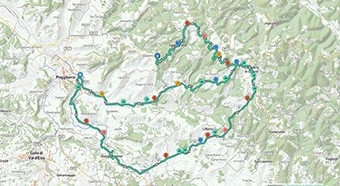
<iframe src="https://plugin.routeyou.com/poiviewer/free/?language=de&params.poi.id=1798517&params.language=en" width="100%" height="600" frameborder="0" allowfullscreen></iframe>

Mehr als 11.800.000 Routen

Mehr als 15.000.000 Benutzer

Mehr als 4.500.000 Sehenswürdigkeiten

Kerkstraat 108
9050 Gentbrugge,Belgien
© 2006-2026 RouteYou - www.routeyou.com