Fuente: Willem Vandenameele
This park is part of the Global Project to Enhance the Lima Riverbanks and its design has a cultural and recreational function. The cultural component draws the visitor's attention to the historical evolution of the humanization of the landscape.
This gave rise to the idea of creating a theme garden that would take visitors on a journey through the history of garden art , whose roots are deeply connected to rural culture.
In addition to the reuse of existing farm structures , erudite gardens from different eras are integrated into the old fields. In the botanical garden, the planting is educational and the greenhouse with the surrounding pond stands out.
The rural culture is still present in the various elements, such as the vineyards, the irrigation systems from the pond and the granite watering cans , the noria, the large threshing floor and the granary.
Roman garden
The garden has always played a very important role in the Roman house. Visitors can see a recreation of a space inspired by the famous Casa dos Repuxos in Conímbriga.
A colonnade of handmade bricks emphasizes the idea of the peristyle around the water garden and the triclinium that overlooks the lake. The peristyle garden forms an indoor-outdoor space in the Roman house that often makes it possible to bring nature into the interior of the house itself.
The mosaic floor of Portuguese cobblestones aims to reflect the influence that Roman culture still has on our cultural traditions today. The use of different design patterns used by the Romans translates the durability of forms through the ages and reveals the richness of this formal grammar.
The Renaissance Garden
The European Renaissance (15th-16th centuries) began in Italy and marked an important stage in the evolution of the humanized landscape, especially in garden art, where true landscape architecture emerged.
Gardens were given a strict geometric structure, often on terraces, and plants played a fundamental role. Water is also a central presence in gardens, because it radiates a sense of tranquility. The development of mathematics applied to hydraulics made it possible to build sophisticated mechanisms for lifting and guiding water, creating waterfalls and numerous versions of water features .
Sculpture also became important at this time, giving meaning to Greek mythology which, through images, played an important role in the composition of gardens. In Portugal, tiles began to be used to decorate gardens.
The dominant species in this area are rhododendrons and azaleas (Rhododendron).
Baroque garden
The Baroque garden (17th-18th century) follows the natural evolution of the Renaissance garden. There was a great increase in the art of topiary and the gardens of boxwood (Buxus sempervirens), with increasingly complex ornamental forms, formed the so-called parterres - the splendor of French-style gardens.
Hydraulics continues to develop and now plays a very important role in the so-called water mirrors , where the reflection makes it possible to enlarge the view, and this effect is often used in Central European gardens.
In an area where Baroque architecture is very prominent, especially in the Solares da Ribeira Lima , this park could not be without Baroque gardens, in which the predominant species in this case is the rose.
Greenhouse
Botanical gardens emerged in Europe in the 16th century under the influence of the discoveries, due to the need to acclimatize, classify and study the properties of plants from the new continents. The Botanical Garden aims to bring together a systematic collection of plants, so that visitors can easily identify them.
The garden is divided into three parts : the herbaceous plants , including grasses, divided into beds separated by grass; the aquatic plants in the lake that surrounds the greenhouse; and the plants in the greenhouse, many of which are now called "houseplants" because they require special climatic conditions to thrive.
Fuente: Willem Vandenameele
 | | Pública | Alemán • Catalán • Danés • Español • Francés • Italiano • Neerlandés

Selecciona una de las actividades más populares a continuación o afina tu búsqueda
Descubre las rutas más bonitas y populares de la zona, cuidadosamente agrupadas y seleccionadas.
Fuente: Willem Vandenameele
Selecciona una de las categorías más populares a continuación o inspírate en nuestras selecciones
Descubre los lugares de interés más bonitos y populares de la zona, cuidadosamente agrupados y selecciondos.
Fuente: Willem Vandenameele
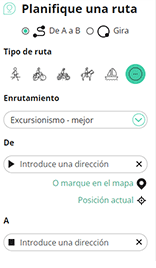
Con RouteYou, es fácil crear tus propios mapas personalizados. Simplemente traza tu ruta, agrega puntos de ruta o nodos, agrega lugares de interés, lugares para comer y beber, y luego compártelo fácilmente con tu familia y amigos.
Planificador de rutas
<iframe src="https://plugin.routeyou.com/poiviewer/free/?language=es&params.poi.id=9008709&params.language=en" width="100%" height="600" frameborder="0" allowfullscreen></iframe>

Más de 11.800.000 rutas

Más de 15.000.000 usuarios

Más de 4.500.000 lugares de interés

Kerkstraat 108
9050 Gentbrugge, Bélgica
© 2006-2026 RouteYou - www.routeyou.com