The exact date is not known, but it is at the beginning of the 13th century that a lord (or a lady) of the castle of Montjardin in Remouchamps granted to his huntsman (Emprardus li Brakni) the right of hunting, fishing and cultivation on his territory would have given. When he died in 1230, this hunter left his rights to the inhabitants of the region on the condition that they would never build a house there and that they would pray to God for the repose of their souls. These lands are designated in all deeds under the name of 'the miraculous Gate of God and Saint Peter of Aywaille'.
When the country became French, the territory of Porallée was nationalized. Then, by decree of 1810, it returns to the common heritage and each owner of the plots retains the enjoyment of the past, for a very modest rental cost called 'aisance'.
La Porallée comes from the words "pour aller" . The territory of the Porallée was part of the duchies of Limburg (in the west) and Luxembourg (in the east). The inhabitants could come and go from one duchy to another as they pleased without paying taxes or tithes. It was a free zone. They even had the opportunity to cultivate a field, graze cattle, take firewood and fish in the Amblève. All this was free.
However, they were forbidden to build any structure on it. In the event of a dispute, the courts of Aywaille, Remouchamps and Henumont issued a judgment called archive documents.
The Porallée was an area with a free zone and is therefore not an old communication route like the Vecquée. The current wide forest road Voie de la Porallée , which runs from the N.697 (Remouchamps - La Reid) to the Ville-au-Bois, near the sources of the Ninglinspo, was in fact the eastern border of this area. Today it still marks the common border between Aywaille and Theux.
The Porallée covered 4,500 'bonniers' or approximately 40 km2, two-thirds of which (in the east) belonged to the Duchy of Luxembourg. It is approximately half of the current area of the municipality of Aywaille.
To put an end to the serious ownership conflicts between the municipalities of Aywaille and Theux, a demarcation was ordered by King Leopold I in 1833. This consists of 9 cylindrical stone pillars placed in a straight line of 7.3 km
Fuente: Wikipedia
 | | Pública | Alemán • Catalán • Danés • Español • Francés • Italiano • Neerlandés

Selecciona una de las actividades más populares a continuación o afina tu búsqueda
Descubre las rutas más bonitas y populares de la zona, cuidadosamente agrupadas y seleccionadas.
Selecciona una de las categorías más populares a continuación o inspírate en nuestras selecciones
Descubre los lugares de interés más bonitos y populares de la zona, cuidadosamente agrupados y selecciondos.
Con RouteYou, es fácil crear tus propios mapas personalizados. Simplemente traza tu ruta, agrega puntos de ruta o nodos, agrega lugares de interés, lugares para comer y beber, y luego compártelo fácilmente con tu familia y amigos.
Planificador de rutas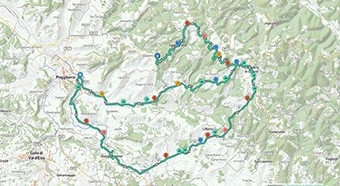
<iframe src="https://plugin.routeyou.com/poiviewer/free/?language=es&params.poi.id=3033918&params.language=en" width="100%" height="600" frameborder="0" allowfullscreen></iframe>

Más de 11.800.000 rutas

Más de 15.000.000 usuarios

Más de 4.500.000 lugares de interés

Kerkstraat 108
9050 Gentbrugge, Bélgica
© 2006-2026 RouteYou - www.routeyou.com