Fuente: Willem Vandenameele


Pietro Leopolod I was Grand Duke of Tuscany.
Together with his new bride, the young regent traveled to Florence, equipped with a detailed set of instructions or "catalogue of conduct" supplied by his mother. As a member of the Imperial dynasty, he was answerable to his eldest brother Joseph, who regarded Tuscany as an outpost of the Austrian monarchy and Leopold as a representative of Habsburg interests.
The new Grand Duke, who was only eighteen years old, with the support of a group of advisers, soon embarked on a major reform program designed to make Tuscany a leading example of the Enlightenment regime.
The young Grand Duke based his reforms on the principles of physiocracy. The main idea of this school of economics was to strengthen agriculture to support systematic population growth, which in turn would lead to an increase in economic power. To this end, the controls on the grain trade were abolished, as well as a series of feudal restrictions, and the property rights of the landowners were strengthened. All this was intended to improve and strengthen the situation of the peasantry in general. New agricultural lands were reclaimed, for example by draining the marshes of the Maremma. This was accompanied by the introduction of the most modern methods of arable farming and animal husbandry.
Incentives to trade were also created through the abolition of the restrictions of the medieval guild system and the standardization of rates and duties.
Another important part of the Grand Duke's program was tax reform, with the abolition of the system of taxation, which had led to injustices and fraud. This was accompanied by statistical studies so that reliable data was available to give an accurate picture of the economic situation of the Duchy.
A new municipal law was introduced to promote the self-government of the municipalities. The inhabitants of the duchy were encouraged to consider themselves citizens rather than disenfranchised subjects, a change symbolized by the abolition of the army, which was replaced by a civilian militia for purely defensive purposes.
In less than two decades, Tuscany was transformed from a stagnant small state living on the remnants of its former significance as a center of the Renaissance, into a modern territorial state at the forefront of Enlightenment Europe.
There is a clear resemblance here to the aims of the Archduke's brother in Austria. In carrying out his reforms, however, Leopold was more cautious and less hasty. He took into account existing structures and thus gained wider support for his modernization program. Contrary to the rather despotic style of Joseph II, who tended to decree his measures from above, Leopold always sought to involve local interest groups, be they aristocratic estates or municipalities.
In 1778, Leopold traveled to Vienna at the invitation of his mother, who hoped to use him as an ally against her co-regent Joseph. During his stay at the Viennese court he gained sobering insights into the deadlocked situation and the conflicts within the family, which he recorded in personal memoranda. His observations, which he wrote in a secret Italian shorthand under the title Stato della famiglia, are an important source for historians today.
A conflict soon arose with the emperor, who had summoned Leopold's eldest son Frans to Vienna to prepare him as successor, because it was more than likely that Joseph would remain childless. Joseph also intended to annex Tuscany to the entire empire, so that Leopold had to promise that the area would return to the main line of the dynasty after his death. However, as soon as Leopold succeeded his brother to the throne, he revoked this agreement and his son Ferdinand took over the regency in Tuscany.
Joseph also prevented the adoption of the constitution for Tuscany that Leopold had had drawn up. The draft contained provisions for strengthening the self-government of the estates, as well as the emancipation of the peasantry from feudal rule and the abolition of censorship. This revolutionary plan was a step too far for his imperial brother, who feared it would set an undesirable precedent.
One of Leopold's successes was the introduction of the new penal code in 1786, which abolished the death penalty and torture. The enlightened conception of law underlying this code is also apparent from the generally mild penalties and the fact that it did not include the crime of lèse-majesté.
Fuente: Willem Vandenameele
 | | Pública | Alemán • Español • Francés • Italiano • Neerlandés

Selecciona una de las actividades más populares a continuación o afina tu búsqueda
Descubre las rutas más bonitas y populares de la zona, cuidadosamente agrupadas y seleccionadas.
Fuente: Willem Vandenameele
Selecciona una de las categorías más populares a continuación o inspírate en nuestras selecciones
Descubre los lugares de interés más bonitos y populares de la zona, cuidadosamente agrupados y selecciondos.
Fuente: Willem Vandenameele
Con RouteYou, es fácil crear tus propios mapas personalizados. Simplemente traza tu ruta, agrega puntos de ruta o nodos, agrega lugares de interés, lugares para comer y beber, y luego compártelo fácilmente con tu familia y amigos.
Planificador de rutas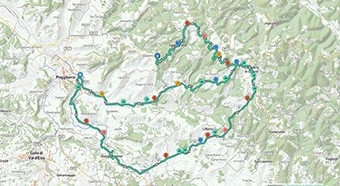
<iframe src="https://plugin.routeyou.com/poiviewer/free/?language=es&params.poi.id=8275415&params.language=en" width="100%" height="600" frameborder="0" allowfullscreen></iframe>

Más de 10.100.000 rutas

Más de 15.000.000 usuarios

Más de 4.500.000 lugares de interés

Kerkstraat 108
9050 Gentbrugge, Bélgica
Contacte con nuestro equipo de atención al cliente o visite nuestro centro de ayuda.
© 2006-2025 RouteYou - www.routeyou.com