Fuente: Willem Vandenameele
The museum is located in the Archbishop's Palace , which was built in the mid- 15th century by order of Archbishop Simone Beccadelli, replacing the older building that stood behind the cathedral .
Of the fifteenth century construction, leaning against the medieval tower , the elegant flamboyant-Gothic three-light window and the Gothic-Catalan portal of Neapolitan origin can still be admired.
Between the sixteenth and seventeenth centuries, the palace was significantly expanded with the construction of the first large courtyard and the balconies on the cathedral floor, which replaced the old loggia. In the following centuries, the building underwent further important transformations, especially in the interiors, which were among the most opulent in Palermo , also due to the political role often assumed by the city's archbishop as temporary president of the kingdom.
Today , parts of the cycle of frescoes created between 1733 and 1734 by Guglielmo Borremans, and the paintings of the Roman Gaspare Fumagalli that covered the vaults and walls of the palace with beautiful false perspectives, have been preserved . In 1972, at the insistence of Archbishop Salvatore Pappalardo, the palace reception rooms were used as the headquarters of the Diocesan Museum.
The museum is spread over 15 rooms pending the completion of the restoration of the ground floor of the building. The collection is intended to offer visitors a glimpse into more than eight centuries of history of the church of Palermo. About 200 paintings, sculptures and decorative works of art were selected, ranging from the 12th to the 19th century, mostly from churches in Palermo that had been destroyed, no longer in use or were not in good security.
Among the works exhibited are especially important : the mosaic with the praying Madonna, the role of the deceased brothers of Antonio Veneziano, Madonna della Spersa, the Coronation of Santa Rosalia by Vito D'Anna, a Gothic-flamboyant three-light window of Catalan derivation, testimony from the late fifteenth century origins of the Archbishop's Palace, the young reclining knight attributed to Francesco Laurana, the frontal with the presentation of Santa Rosalia to the Virgin, embroidered in silk and corals.
Fuente: Willem Vandenameele
 | | Pública | Alemán • Catalán • Español • Francés • Italiano • Neerlandés

Selecciona una de las actividades más populares a continuación o afina tu búsqueda
Descubre las rutas más bonitas y populares de la zona, cuidadosamente agrupadas y seleccionadas.
Fuente: Willem Vandenameele
Selecciona una de las categorías más populares a continuación o inspírate en nuestras selecciones
Descubre los lugares de interés más bonitos y populares de la zona, cuidadosamente agrupados y selecciondos.
Fuente: Willem Vandenameele
Con RouteYou, es fácil crear tus propios mapas personalizados. Simplemente traza tu ruta, agrega puntos de ruta o nodos, agrega lugares de interés, lugares para comer y beber, y luego compártelo fácilmente con tu familia y amigos.
Planificador de rutas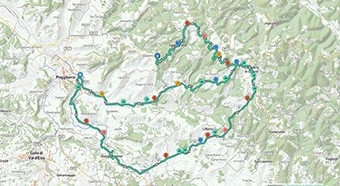
<iframe src="https://plugin.routeyou.com/poiviewer/free/?language=es&params.poi.id=8660364&params.language=en" width="100%" height="600" frameborder="0" allowfullscreen></iframe>

Más de 10.100.000 rutas

Más de 15.000.000 usuarios

Más de 4.500.000 lugares de interés

Kerkstraat 108
9050 Gentbrugge, Bélgica
Contacte con nuestro equipo de atención al cliente o visite nuestro centro de ayuda.
© 2006-2025 RouteYou - www.routeyou.com