Fuente: Willem Vandenameele


The Church of Santa Maria delle Nevi is a Catholic place of worship in Siena on Via dei Montanini.
It was built between 1471-1472 and 1477 by Giovanni Cinughi, Bishop of Pienza, for his family. After his death, however, the funds to complete the interior were lacking.
It was originally part of the ancient monastery of Sant'Egidio, known as the "Suore Cappuccine" (Capuchin Sisters), which stretched from one side of the Via Malavolti to the other, looping around it. Later, to allow the construction of the new Piazza Umberto I, the monastery was bought by the municipality and demolished in the early 20th century. Of the old monastery, only the small Renaissance church of the Madonna delle Nevi was saved, thanks to Mayor Lisini, who as a historian and scholar strongly opposed the demolition of the church, because he believed that further demolition of the small building and the housed works was not necessary.
The building has a classic travertine facade, decorated with decorative elements (tympanum, pilaster bands, portal in pietra serena and the patron's coat of arms in marble).
The fine Renaissance architecture, with a single nave and two cross vaults, is attributed to Bastiano di Corso or Lorenzo di Pietro, known as Vecchietta, or another student of Francesco di Giorgio. The building is illuminated by the round front window and the two left side windows, while the two right windows are designed but left unfinished, as is the entire decoration of the side walls and vaults.
On the main altar is the great Madonna delle Nevi, a masterpiece signed and dated by Matteo di Giovanni (1477). It shows the enthroned Madonna and Child flanked by Saints Peter and John the Evangelist and in front of Saints Laurence and Catherine of Siena. Behind them stand numerous angels holding trays of snow that fell in Rome on August 5, 358, where Pope Liberius decided to build the Basilica of Santa Maria Maggiore. The predella shows the story of the snowfall and the coats of arms of the Cinughi family.
The stucco work on the sides of the altar with St. Joseph and St. Mary Magdalene dei Pazzi is attributed to the 18th century Sienese sculptor Giuseppe Maria Mazzuoli.
Fuente: Willem Vandenameele
 | | Pública | Alemán • Francés • Italiano • Neerlandés

Selecciona una de las actividades más populares a continuación o afina tu búsqueda
Descubre las rutas más bonitas y populares de la zona, cuidadosamente agrupadas y seleccionadas.
Fuente: Willem Vandenameele
Selecciona una de las categorías más populares a continuación o inspírate en nuestras selecciones
Descubre los lugares de interés más bonitos y populares de la zona, cuidadosamente agrupados y selecciondos.
Fuente: Willem Vandenameele
Con RouteYou, es fácil crear tus propios mapas personalizados. Simplemente traza tu ruta, agrega puntos de ruta o nodos, agrega lugares de interés, lugares para comer y beber, y luego compártelo fácilmente con tu familia y amigos.
Planificador de rutas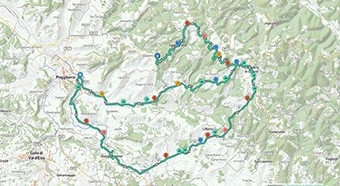
<iframe src="https://plugin.routeyou.com/poiviewer/free/?language=es&params.poi.id=8280714&params.language=en" width="100%" height="600" frameborder="0" allowfullscreen></iframe>

Más de 10.100.000 rutas

Más de 15.000.000 usuarios

Más de 4.500.000 lugares de interés

Kerkstraat 108
9050 Gentbrugge, Bélgica
Contacte con nuestro equipo de atención al cliente o visite nuestro centro de ayuda.
© 2006-2025 RouteYou - www.routeyou.com