Fuente: Rotary Club Overijse-Zoniën


The Capuchin Forest - a bit of history
The Capuchin Forest is located between the Park of Tervuren and the actual Sonian Forest. The Capuchin Forest is often referred to as the northeastern part of the Sonian Forest. The Arboretum is a part of the Capuchin Forest. The forest owes its name to the Capuchin monastery that was founded in 1626 at the request of Isabella of Spain. For this purpose, a part of the forest had to be cleared at the location of the current Achtster. We will walk around part of the former estate, but there is not much left to see as the monastery was demolished by order of the French government in 1798, and the area, along with the nearby silted monastery pond, was reforested.
During the Dutch period in 1822, the Sonian Forest, and thus also the Capuchin Forest, was transferred by King Willem I to the then-established trading company later known as the General Society. At that time, the Sonian Forest still covered about 10,000 hectares. Almost 60% of the forest was sold to private individuals from then on, especially after the independence of Belgium in 1830, often for exploitation and subdivision. The Capuchin Forest was also sold to Leopold I in 1842. The remaining part, or 4,400 hectares of the Sonian Forest, was transferred to the Belgian State in 1843. That state is still the owner today.
Leopold I had the majority of the estate deforested and, for several decades, used it as agricultural land through a number of local tenants. In 1853, Leopold I donated the part south of the Dronkenmansdreef to his master of the horse, Count Charles de Marnix. This part is still owned by the de Marnix family today but is managed by the Agency for Nature and Forest.
Leopold II had the Capuchin Forest reforested in the 1880s-90s, but not with the ubiquitous beech present in the Sonian Forest, but with pedunculate oak on the better loamy soils and Scots pine and Norway spruce on the poorer sandy soils. However, Leopold II did not just want to create a productive forest but also a forest park. Hence the creation of the Royal Walk, the beautiful beech avenues, and the open grass fields that were established from 1880 onwards. The construction of the Arboretum did not begin until later, in 1902. Today, the Capuchin Forest, including the Arboretum, is part of the Royal Donation.
 | | Pública | Alemán • Danés • Español • Francés • Italiano • Neerlandés

Selecciona una de las actividades más populares a continuación o afina tu búsqueda
Descubre las rutas más bonitas y populares de la zona, cuidadosamente agrupadas y seleccionadas.
Fuente: Rotary Club Overijse-Zoniën
Selecciona una de las categorías más populares a continuación o inspírate en nuestras selecciones
Descubre los lugares de interés más bonitos y populares de la zona, cuidadosamente agrupados y selecciondos.
Fuente: Rotary Club Overijse-Zoniën
Con RouteYou, es fácil crear tus propios mapas personalizados. Simplemente traza tu ruta, agrega puntos de ruta o nodos, agrega lugares de interés, lugares para comer y beber, y luego compártelo fácilmente con tu familia y amigos.
Planificador de rutas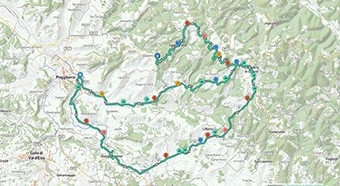
<iframe src="https://plugin.routeyou.com/poiviewer/free/?language=es&params.poi.id=7576333&params.language=en" width="100%" height="600" frameborder="0" allowfullscreen></iframe>

Más de 11.800.000 rutas

Más de 15.000.000 usuarios

Más de 4.500.000 lugares de interés

Kerkstraat 108
9050 Gentbrugge, Bélgica
© 2006-2026 RouteYou - www.routeyou.com