Source: Willem Vandenameele
In the Norman era, the place of worship was built in 1165.
The church was part of a complex of buildings to provide hospitality and care to pilgrims following the "via Francigena" that went from France to the Holy Land. The term "Guilla" or "Guidda", from Arabic derivation, denotes a river or a spring. In concrete terms, it refers to the toponyms that can be attributed to the part of the city surrounded by the Papireto River.
The structure has a single square nave and the apse of the same shape opens in line with the entrance. Close to the walls are two short chapels with altars and statues. On Good Friday, the two statues are carried on the shoulders by members of the congregation. A large crowd of believers takes part in the procession, which is one of the manifestations of the Holy Week rituals in Palermo.
Source: Willem Vandenameele - Wikipedia
 | | Public | Italien • allemand • catalan • danois • espagnol • français • néerlandais

Sélectionnez l'une des activités les plus populaires ci-dessous ou affinez votre recherche
Découvrez les plus beaux et les plus populaires itinéraires du secteur, soigneusement regroupés dans des sélections appropriées.
Source: Willem Vandenameele
Sélectionnez l'une des catégories les plus populaires ci-dessous ou inspirez-vous de nos sélections
Découvrez les plus beaux et les plus populaires points d'intérêt du secteur, soigneusement regroupés dans des sélections appropriées.
Source: Willem Vandenameele
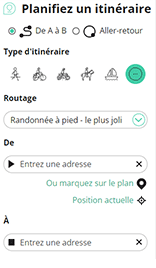
Avec RouteYou, vous pouvez facilement créer vos propres cartes personnalisées. Tracez votre itinéraire, ajoutez des points de passage ou des points-nœuds, planifiez des points d'intérêt et des lieux de restauration, et partagez le tout avec votre famille et vos amis.
Planificateur d'itinéraire
<iframe src="https://plugin.routeyou.com/poiviewer/free/?language=fr&params.poi.id=8660309&params.language=en" width="100%" height="600" frameborder="0" allowfullscreen></iframe>

Plus de 11 800 000 itinéraires

Plus de 15 000 000 d'utilisateurs

Plus de 4 500 000 points d'intérêts

Kerkstraat 108
9050 Gentbrugge, Belgique
© 2006-2026 RouteYou - www.routeyou.com