Copyright: Creative Commons
Fintele or De Fintele is a small settlement in Pollinkhove, a district of Lo-Reninge in the Belgian province of West Flanders. It lies one and a half kilometers south of the center of Pollinkhove, at the confluence of the Lovaart and the IJzer, where there is a lock and a spillway. The Grote Beverdijkvaart also flows into here. The hamlet is located on the left bank of the IJzer, behind the Veurne-Ambachtsdijk, to the east of the Lovaart. De Fintele was protected as a village view in 1994.
On the left bank of the IJzer, the Veurne-Ambachtsdijk was constructed during the 12th century, providing protection against the IJzer water. A towpath was established, around which the hamlet would later develop.
References from the 13th century mention a windlass at the confluence. This was used to haul boats over a dam from one river to the other. That 'winde' consisted of two large wheels on a thick axle and was situated on the IJzer bank at the mouth of the Lovaart. Small planks were attached to the wheels on which the women of Fintele walked, thus turning the wheels. The ship, which was connected to the wheels by ropes, then glided along a channel greased with fat. The vessels that were transferred in this way had a carrying capacity of 12 to 15 tons and a draft of only 50 cm.
The name Fintele is said to originate from "Wind-ele", composed of "Winde" (windlass) and "-ele" (place indication). For the following centuries, the towpath was a fief that was dependent on the Burg of Veurne. It remained in the possession of the family of Pollinkhove until the 16th century. The towpath was destroyed by the Malcontents in 1581 but was soon restored. In 1649, a redoubt was established slightly to the south by the Spaniards during conflicts with the French.
On the Ferraris map of the 1770s, Fintele had about 35 houses along both sides of the Lovaart. The Lovaart on these maps still makes a sharp eastern bend before flowing into the IJzer. In the 1820s, the Lovaart was deepened and straightened in Fintele. That old arm would not be filled in until later in the 20th century. The towpath disappeared and a lock was built. The number of inhabitants in the hamlet declined, halving by the middle of the 19th century.
During World War I, Fintele was near the front but was not heavily damaged. In World War II, just before the capitulation in May 1940, the lock was blown up by the Belgians for tactical reasons. In 1943, the whole was rebuilt. After the war, shipping transport on the IJzer and Lovaart ceased, the economic importance of Fintele decreased, and habitation further declined.
 | | Public | Danish • Dutch • French • German • Italian • Spanish

Select one of the most popular activities below or refine your search.
Discover the most beautiful and popular trails in the area, carefully bundled into appropriate selections.
Copyright: Creative Commons
Select one of the most popular categories below or be inspired by our selections.
Discover the most beautiful and popular attractions in the area, carefully bundled in appropriate selections.
Copyright: Creative Commons
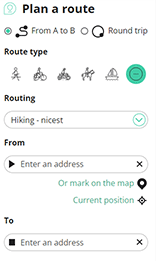
With RouteYou, it's easy to create your own customised maps. Simply plot your route, add waypoints or nodes, add places of interest and places to eat and drink, and then easily share it with your family and friends.
Route planner
<iframe src="https://plugin.routeyou.com/poiviewer/free/?language=en&params.poi.id=7466016" width="100%" height="600" frameborder="0" allowfullscreen></iframe>

More than 11,800,000 routes

More than 15,000,000 users

More than 4,500,000 points of interest

Kerkstraat 108
9050 Gentbrugge, Belgium
© 2006-2026 RouteYou - www.routeyou.com