The Eifel National Park is the fourteenth national park in Germany and the only one in North Rhine-Westphalia. It is located in the northern part of the Eifel, between Nideggen in the north and Gemünd in the south, and the Belgian border in the west. Since January 1, 2004, it has been a national park.
The area is approximately 10,700 hectares in size, borders the Rurstausee in the northwest, and includes the adjacent Urfttalsperre with the former Vogelsang Camp, a military training ground that was used by the Belgian army and has been part of the park since 2006. The visitor center is located here.
The national park protects the beech forest, which has remained in the northern Eifel to this day, but originally covered almost the entire Eifel. A large contiguous forest area with a high proportion of beech trees is located on the Kermeter mountain.
Due to the way the forest was used in the past, especially for charcoal production, large areas were converted into forest. The Prussians replanted sections with spruce trees in the 19th century. Spruce grows faster than many deciduous tree species, making forestry more economical. Because nature is left to itself in the newly formed national park, many coniferous trees can fall victim to bark beetles such as the spruce bark beetle. The slopes of the Kermeter, a mountain bordered by the Rurtalsperre to the north and west and by the Urfttalsperre to the south, are affected as a result. The dry climate is favorable for the bark beetle. This is a natural process that is being monitored. The spread to other coniferous forests outside the national park will be prevented in due course. The return of the beech is encouraged in large parts. Partially, planting is considered. Other areas need support. The beech requires shade, and a new beech forest is already growing in the shade of the coniferous trees. In any case, it will take several decades for the beech to become the most common tree again. Furthermore, there are about 80 protected plant species and 150 animal species that are listed as endangered.
Not all parts of the national park are accessible. There are still minefields from World War II where there are glass mines. This type of mine cannot be removed because there is no detection equipment for it. Even dogs cannot be used here because explosives are buried everywhere in the ground. Injuries from these mines are almost untreatable because glass is hardly visible with medical (X-ray) equipment. Another type of mine that is present, the concrete mine, will deactivate itself over time due to moisture. This is not possible with the hermetically sealed glass mines.
 | | Public | Danish • Dutch • French • German • Italian • Spanish

Select one of the most popular activities below or refine your search.
Discover the most beautiful and popular trails in the area, carefully bundled into appropriate selections.
Select one of the most popular categories below or be inspired by our selections.
Discover the most beautiful and popular attractions in the area, carefully bundled in appropriate selections.
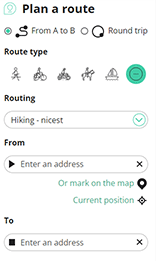
With RouteYou, it's easy to create your own customised maps. Simply plot your route, add waypoints or nodes, add places of interest and places to eat and drink, and then easily share it with your family and friends.
Route planner
<iframe src="https://plugin.routeyou.com/poiviewer/free/?language=en&params.poi.id=886726" width="100%" height="600" frameborder="0" allowfullscreen></iframe>

More than 11,800,000 routes

More than 15,000,000 users

More than 4,500,000 points of interest

Kerkstraat 108
9050 Gentbrugge, Belgium
© 2006-2026 RouteYou - www.routeyou.com