At their narrowest, the Vosges measure barely a few kilometers. On the Alsatian side, the town of Saverne (186 m, 15,000 inhabitants) is located there, the gateway to Alsace. In the 10th century, the bishops of Strasbourg established themselves there; from the Haut-Barr castle, they controlled the surrounding areas. With Saverne, they had a significant asset in their struggle against the Strasbourg bourgeoisie. After being defeated in the struggle, they moved their seat to Saverne, where they would remain until the Revolution. Less than ten years before the great revolution, Cardinal Louis de Rohan had a new grand episcopal palace built there. A charming building, this Château des Rohan, is aptly nicknamed the "Versailles of Alsace." The rear facade, facing the garden, is the most impressive: a classic façade in the Louis XVI style, extremely wide and minimalist. Just as linear and austere is the layout of the park, which - in a curious contrast - is framed on two sides by the Marne-Rhine canal, which is forced to make two sharp right-angle turns. Today, the castle houses a museum, located in the right wing at the front of the building. On the lower level is the archaeological department, with many discoveries from the Gallo-Roman era. At that time, Saverne was called "Tres Tabernae" (the three taverns), a town with three levels: a strongpoint at the peak of the Saverne Pass, an upper town, and a lower town at the foot of the mountain. The collections on the second floor are dedicated to the art and history of medieval and modern Saverne (from mid-June to mid-September every afternoon, except Tuesday, open on Sunday and in the morning). The historic city center is small and manageable; the canal with the lock is truly atmospheric here. The main attractions are located on or near the main street, the Grand'rue. The right side of the street (calculated from the castle) is the most eye-catching: timber-framed houses, with even a stray Art Nouveau façade nestled between the two. The centerpiece here is the Maison Katz, a richly carved 17th-century timber-framed house, located right next to the neo-Renaissance town hall. Further to the left, a bit behind, the Romanesque tower of the Church of Notre-Dame de la Nativité can be seen. The church, which is otherwise Gothic, houses valuable furnishings from the late Gothic and Renaissance periods. The pulpit (1495) was designed by the architect and sculptor Hans Hammer, who also designed the pulpit of the Strasbourg Cathedral. Also mentioned here are Renaissance baptismal fonts from 1615 and a Gothic deposition (left before the choir). In the windows of the bishop's chapel, we see stained glass from the 15th century. A student of Peter Hemmel von Andlau painted Christmas and Passion stories there. The chapel is enclosed by beautiful Louis XVI style gates.
To the southwest of Saverne, a narrow ridge separates the Zorn valley from the Alsatian plain. It is hard to imagine a better location for a castle. At the farthest point are the ruins of Haut-Barr Castle (458 m, accessible from Saverne via D171). It's no wonder that Haut-Barr has been popularly called "the eye of Alsace." The owner of this castle controlled one of the most important entrances to Lorraine, and had a royal view of the Alsatian plain. How does the proud eye show itself today? On a rock formation 200 meters long and irregular in shape, we find a combination of remains of buildings from different eras. The oldest pieces date back to the Romanesque era: among them, the Saint-Nicholas chapel (greatly restored in 1880) is the best preserved. In the middle of the rocky massif, which roughly disintegrates into three pieces, there are wall remains of the hexagonal living space of the Romanesque castle. From there, we can cross the so-called "devil's bridge" at the top of Markstein, the impressive rock mass located at the southernmost point of the massif.
In addition to the gateway, two Renaissance bastions remained: one immediately to the right of the neo-Gothic inn, and the other at the northern end of the complex. These were not built so much for military reasons, but more for show. In 1583, Bishop Johannes van Manderscheid converted Haut-Barr into a club-house for the "horn brotherhood," a club of merry drinkers. Neither the brotherhood nor the castle survived the Thirty Years' War. Beneath the Haut Barr rock, about 200 meters before the entrance to the castle, stands the Tower of the Ancient Chappe Telegraph. Claude Chappe (1763-1805) is the inventor of an optical telegraph system consisting of towers with signal arms mounted on high points. This tower was a signaling station on the Strasbourg - Paris line, which operated from 1798 to 1852. There is a small museum that is open every day except Monday from June to September. Further south, on the ridge, are the mines of Grand and Petit Geroldseck (481 m). The Grand Geroldseck is one of the oldest castles (early 12th century) in Alsace. In the 13th century, the noble family that managed the castle became the richest and most powerful family in the region; the ambitious Walther von Geroldseck even went to the bishop of Strasbourg, where he got into trouble with the bourgeoisie. The hallmark of the castle is the robust square keep from the 12th century; the blind arcades and vaults of the former knights' hall date back to the 13th century. To the north of Haut-Barr, on the other side of the Zorn valley, are the remains of Greifenstein (360 m, from Saverne take D32, after 2 km turn right onto a small side road, from a parking lot past the railway in 45 minutes walking uphill). Here too, there are two castles, as evidenced by the two keeps that protrude above the trees.
 | | Public | Danish • Dutch • French • German • Italian • Spanish
Address: Saverne, Alsace, France
Statistics
Select one of the most popular activities below or refine your search.
Discover the most beautiful and popular trails in the area, carefully bundled into appropriate selections.
Source: © Ralph Hammann - Wikimedia Commons
Copyright: Public domain
Select one of the most popular categories below or be inspired by our selections.
Discover the most beautiful and popular attractions in the area, carefully bundled in appropriate selections.
Source: © Ralph Hammann - Wikimedia Commons
Copyright: Public domain
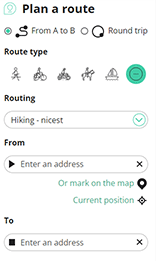
With RouteYou, it's easy to create your own customised maps. Simply plot your route, add waypoints or nodes, add places of interest and places to eat and drink, and then easily share it with your family and friends.
Route planner
<iframe src="https://plugin.routeyou.com/poiviewer/free/?language=en&params.poi.id=2333566" width="100%" height="600" frameborder="0" allowfullscreen></iframe>

More than 11,800,000 routes

More than 15,000,000 users

More than 4,500,000 points of interest

Kerkstraat 108
9050 Gentbrugge, Belgium
© 2006-2026 RouteYou - www.routeyou.com