The Lima is a river of the Tuscan-Emilian Apennines, interesting the provinces of Pistoia and Lucca with the municipality of Bagni di Lucca that it borders for 24 km, flowing into Chifenti. It is the main left tributary of the Serchio, in terms of length, basin area, and water flow.
It originates at the Abetone Pass, draining, among other things, the entire southern slope of the long chain between Corno alle Scale and Libro Aperto, as well as, through its major tributary Sestaione, another vast Apennine section that includes Monte Gomito and Alpe Tre Potenze.
Its basin is completely developed among mountains of considerable height, always abundantly snow-covered in winter and subject to heavy precipitation even in the summer months, so the river is characterized by high flows even in midsummer: the minimum flow at the confluence with the Serchio rarely drops below 10 m³/s, but the average annual flow is nearly 20 m³/s, in any case slightly less than half of that of the Serchio. This is precisely one of the main reasons that have led to its intensive use for hydroelectric purposes.
After an initial stretch flowing in a NW-SE direction, it makes a wide curve around the Alpe Tre Potenze - Monte Caligi chain which, in the terminal stretch, leads it to take a west-southwest direction. Moreover, the course can be divided into two distinctly different parts in terms of geomorphological and landscape characteristics. After the first stretch, which runs through a fairly wide alpine-type valley, cloaked in forests especially on the right hydraulic slope, in the locality of La Lima, where the roads converge that, with steep climbs, lead to the Abetone Pass 1,388 m above sea level and the Oppio Pass 821 m above sea level, it enters a narrow and winding gorge also traversed by the S.S. 12 of the Abetone and Brenner passes, skirting, among others, on the left hydraulic side, the sheer mountain known as Penna di Lucchio, on which the hamlet of Lucchio is located at mid-slope.
Among the places touched by the Lima river, there are Cutigliano and Popiglio in the province of Pistoia. It borders the entire territory of Bagni di Lucca for 24 km from Lucchio until Fornoli where the river merges into the Serchio, almost doubling its flow in every season.
Source: Wikipedia.org
Droits d'auteur: Creative Commons 3.0
 | | Public | Italien • allemand • français • néerlandais
Adresse: Lucca, Italie
Statistiques
Sélectionnez l'une des activités les plus populaires ci-dessous ou affinez votre recherche
Découvrez les plus beaux et les plus populaires itinéraires du secteur, soigneusement regroupés dans des sélections appropriées.
Sélectionnez l'une des catégories les plus populaires ci-dessous ou inspirez-vous de nos sélections
Découvrez les plus beaux et les plus populaires points d'intérêt du secteur, soigneusement regroupés dans des sélections appropriées.
Avec RouteYou, vous pouvez facilement créer vos propres cartes personnalisées. Tracez votre itinéraire, ajoutez des points de passage ou des points-nœuds, planifiez des points d'intérêt et des lieux de restauration, et partagez le tout avec votre famille et vos amis.
Planificateur d'itinéraire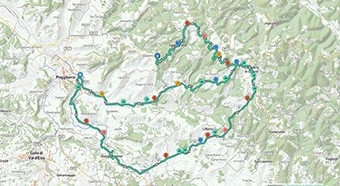
<iframe src="https://plugin.routeyou.com/poiviewer/free/?language=fr&params.poi.id=1679424&params.language=en" width="100%" height="600" frameborder="0" allowfullscreen></iframe>

Plus de 10 100 000 itinéraires

Plus de 15 000 000 d'utilisateurs

Plus de 4 500 000 points d'intérêts

Kerkstraat 108
9050 Gentbrugge, Belgique
Contactez notre équipe de support client ou visitez notre centre d'aide.
© 2006-2026 RouteYou - www.routeyou.com