The Citadel of Namur is located on the hill where the Sambre and the Meuse meet, at the crossroads of several international routes. The function of the fortress was to defend and guard this intersection. There has been fierce fighting over the castle over the centuries.
Although the location has been inhabited occasionally since prehistoric times , it only acquired a military function in the 3rd century with the construction of a sheet pile wall and the deepening of a natural ditch into a defensive moat.
In the Middle Ages, a fortified residence was built on the top of the rock , which was gradually transformed into a real castle.
At the time, the castle consisted of two parts : the castle itself and a sheet pile wall in front of it.
The castle was then surrounded by towers and high walls. Within the enclosure were the residence of the counts of Namur, a collegiate church surrounded by the canons' homes , several auditoriums (reception rooms), a large tower, a bakery, a cellar, stables, chapels, a place for falconry, wells , water reservoirs and so on.
The second part , behind the defensive moat, consisted of a wall and four towers . This defensive wall surrounded the rocky point between the Sambre and the Meuse. Only the outlines of this large fortress remain : three towers, parts of walls and some ruins of the defenses.
From 1519 onwards, the conflict between Charles V, Emperor of our territories, and the French King François I led to a real arms race . This provided the impetus for an accelerated improvement of the artillery and development of weather work. A new form of defense appears, that of the underground construction with bastions. Most characteristic of that construction are the lower, wider walls that are covered with a layer of earth . In Namur, a bastion front known as the Mediaan is built on top of the fortress. It includes a courtine (wall) between two bastions, each containing a casemate . Despite later modifications, the architecture of this part is still visible , including the casemates.
After Spain became a party to the Thirty Years' War (1618-1648), the Citadel of Namur underwent significant improvements and reinforcement.
Between 1631 and 1675 a new defensive section was constructed, called 'Terra Nova' (new ground). It is bordered at its highest point by a large hornwork flanked by two half-bastions, while a complete bastion provides protection on the side of the Sambre. The moat and the shape of the fortifications can still be seen here.
Over the centuries, defenses have been concentrated on the higher parts of the hill to protect the two main weak points of the Citadel: the ravine of La Foliette that shelters attackers as they approach on the gently sloping slope, and the lower places that favor the attackers because they come from above.
After several interventions that largely stripped the fortress of its military function and a partial reconstruction, the last major fortification works of the Citadel were carried out between 1815 and 1830. After the French defeat at Waterloo , the victorious countries aimed to invade France within its borders. to close . To this end, a new belt of fortifications was constructed. The Citadel was rebuilt by the Dutch, partly along the route of the old walls. This construction is now clearly visible, approximately 90 percent of the Citadel as we know it today dates from this late period.
From the end of the 19th century, the construction of nine concrete forts around Namur made the Citadel useless as a means of defense . The Citadel was transformed into a recreation and walking center . A hotel, a stadium and an open-air theater were built on the highest part of the site.
Access to this location was improved by the construction of two roads, a tram line and a funicular .
Only the Mediaan and Terra Nova parts retained their military function. They mainly served as barracks. But the Citadel played a greater military role during the Second World War as the command post of the Defense Line of Namur . The last military regiment left in 1977.
An underground tunnel system was constructed under these fortifications in various phases between the 16th and 20th centuries . Originally the corridors were seven kilometers long in total, but now they measure about four kilometers. They are the largest citadel network in Europe. Leading military engineers left their mark on the construction of the corridors, especially the Frenchman Sébastien le Prestre de Vauban (1633-1707) and the Dutchman Menno van Coehoorn (1641-1704).
It is now possible to visit the Citadel of Namur in different ways: You can discover the complex on your own with a walk in the wooded park . The Terra Nova Visitor Center offers visitors a journey back in time, a journey through the history of Namur and the Citadel through films, models and documents. You can explore the entire site on a tourist train , enjoying beautiful views over the Sambre and Meuse valleys, accompanied by an audio commentary with historical information. The underground tour takes visitors on a journey through the military past of the Citadel, deep into the interior of the fortress. The tour is enhanced with images & sound that enriches the introduction and makes it more fun.
Fuente: Willem Vandenameele
 | | Pública | Alemán • Catalán • Danés • Español • Francés • Italiano • Neerlandés

Selecciona una de las actividades más populares a continuación o afina tu búsqueda
Descubre las rutas más bonitas y populares de la zona, cuidadosamente agrupadas y seleccionadas.
Fuente: visitardenne.com
Selecciona una de las categorías más populares a continuación o inspírate en nuestras selecciones
Descubre los lugares de interés más bonitos y populares de la zona, cuidadosamente agrupados y selecciondos.
Fuente: visitardenne.com
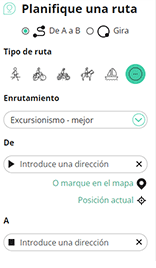
Con RouteYou, es fácil crear tus propios mapas personalizados. Simplemente traza tu ruta, agrega puntos de ruta o nodos, agrega lugares de interés, lugares para comer y beber, y luego compártelo fácilmente con tu familia y amigos.
Planificador de rutas
<iframe src="https://plugin.routeyou.com/poiviewer/free/?language=es&params.poi.id=8667387&params.language=en" width="100%" height="600" frameborder="0" allowfullscreen></iframe>

Más de 10.100.000 rutas

Más de 15.000.000 usuarios

Más de 4.500.000 lugares de interés

Kerkstraat 108
9050 Gentbrugge, Bélgica
Contacte con nuestro equipo de atención al cliente o visite nuestro centro de ayuda.
© 2006-2025 RouteYou - www.routeyou.com