Fuente: Jan Rymenams
According to an ordinance of 18 May 1852, defences had to be planted with deciduous trees, coppice and hedges. In peacetime, the wood was partly sold and partly used for maintenance of the military installations. There was a large part of less economic wood permanently present. The purpose of this was to hinder the enemy in approaching the fortress. It is no coincidence that hawthorn was planted, a species that we still encounter frequently today and that forms dense thickets.
In the winters of 1855 to 1857, 5,271 oaks, 704 elms (elms), 1,584 beech, 4,100 alders, 6,800 willows and 19,125 hawthorns were planted.
After the city walls had lost their military purpose, this 'forest' functioned as a place for the people of Diest to stroll. But the joy was relatively short-lived. The city acquired the ramparts and used them as an ideal quarry for stones and sand. The pits were filled with garbage. The trees were uprooted and sold. Despite the protests of nature-loving associations, the leveling continued, and miraculously, part of the northeastern fortress was preserved.
It is remarkable that a 'classification' as a landscape was only considered in 1963, but that an actual protection as a 'cityscape' would not be achieved until 25 May 1996!
Of the original tall plantations, only a few beech trees remained along the Leopoldvest and the Antwerpsestraat. Due to the presence of giant fungus, several beech trees had to be uprooted in 1998-1999.
The remaining part of the rampart between the Halve Maan and the station, along the current Leopoldvest, was replanted in 1959, during the construction of the ring road and at the insistence of city archivist Van der Linden, by the then 'Green Plan' (Ministry of Public Works). This planting occupies a large part of the 'plongée' (upper surface) of the main rampart between the Schaffensepoort and the car park near the stadium. It consists of a double row of maples, usually Norway maple and also common maple and, exceptionally, also Italian poplar, white maple or Dutch linden.
Interestingly, we can see a special species of the maple family on the ramparts: Spanish maple, with a clearly recognizable 'lobed' leaf. It is a species that you are more likely to find in calcareous and very sunny places.
Fuente: Jan Rymenams
 Azure
Azure | | Pública | Neerlandés

Selecciona una de las actividades más populares a continuación o afina tu búsqueda
Descubre las rutas más bonitas y populares de la zona, cuidadosamente agrupadas y seleccionadas.
Fuente: Jan Rymenams
Selecciona una de las categorías más populares a continuación o inspírate en nuestras selecciones
Descubre los lugares de interés más bonitos y populares de la zona, cuidadosamente agrupados y selecciondos.
Fuente: Jan Rymenams
Con RouteYou, es fácil crear tus propios mapas personalizados. Simplemente traza tu ruta, agrega puntos de ruta o nodos, agrega lugares de interés, lugares para comer y beber, y luego compártelo fácilmente con tu familia y amigos.
Planificador de rutas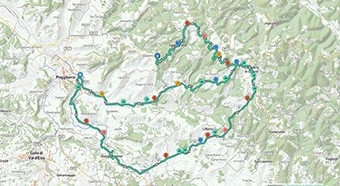
<iframe src="https://plugin.routeyou.com/poiviewer/free/?language=es&params.poi.id=8251526&params.language=en" width="100%" height="600" frameborder="0" allowfullscreen></iframe>

Más de 10.100.000 rutas

Más de 15.000.000 usuarios

Más de 4.500.000 lugares de interés

Kerkstraat 108
9050 Gentbrugge, Bélgica
Contacte con nuestro equipo de atención al cliente o visite nuestro centro de ayuda.
© 2006-2025 RouteYou - www.routeyou.com