Fuente: Willem Vandenameele


Plaza de Armas in Seville, also known as Plaza de Armas station (where the city's current bus station is located), was originally a train station that operated between 1901 and 1990. It was then known as 'Córdoba Station' and was built by the Madrid, Zaragoza and Alicante railway company (MZA).
For many years it was also one of Seville's main train stations and the terminal for trains from Meseta, Córdoba, Huelva and Extremadura.
In addition to the neo-Mudejar style passenger building, the station formed a complex with freight and classification facilities. After the nationalization of the railway network, in 1941, the facilities were integrated into the Renfe network. After its closure, the building housing this station became a shopping center with several cinemas and restaurants .
The building that housed the then train station has a regionalist and neo-Mudejar style, inspired by the Great Mosque of Tangier and the Courtyard of the Lions of the Alhambra in Granada . The building is divided into three parts. The central and largest one was closed on one side with a large glass and iron window, while the other part was open to the passage of trains, which left the station perpendicular to the main entrance of the building.
In the beginning, the place where the station was later built was a suburb of the city where cattle were brought for grazing.
Already in the 19th century, this area would be chosen by the troops stationed in Seville at the time to carry out their maneuvers and exercises . Although this cannot be said with certainty, this could be the origin of this station's name , referring to the vast central patios of the barracks intended for this purpose. In the same way, it was also called Campo de Marte, Campo de Paradas (military parades) or Campo de Bailén (for the famous battle against the Gabachos) and Campo del Ejercicio.
However , parades and military events continued to take place in the Plaza de Armas. Moreover, in the second half of the 19th century, this was the place where the executions of those convicted of political crimes took place in times of civil wars, revolutions, overthrows, etc.
One of these was that of the 82 young people from Seville who would give the name to the famous 'mourning stone' of the capital.
Fuente: Willem Vandenameele
 | | Pública | Alemán • Catalán • Danés • Español • Francés • Italiano • Neerlandés

Selecciona una de las actividades más populares a continuación o afina tu búsqueda
Descubre las rutas más bonitas y populares de la zona, cuidadosamente agrupadas y seleccionadas.
Fuente: Willem Vandenameele
Selecciona una de las categorías más populares a continuación o inspírate en nuestras selecciones
Descubre los lugares de interés más bonitos y populares de la zona, cuidadosamente agrupados y selecciondos.
Fuente: Willem Vandenameele
Con RouteYou, es fácil crear tus propios mapas personalizados. Simplemente traza tu ruta, agrega puntos de ruta o nodos, agrega lugares de interés, lugares para comer y beber, y luego compártelo fácilmente con tu familia y amigos.
Planificador de rutas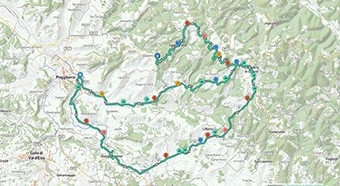
<iframe src="https://plugin.routeyou.com/poiviewer/free/?language=es&params.poi.id=8740218&params.language=en" width="100%" height="600" frameborder="0" allowfullscreen></iframe>

Más de 10.100.000 rutas

Más de 15.000.000 usuarios

Más de 4.500.000 lugares de interés

Kerkstraat 108
9050 Gentbrugge, Bélgica
Contacte con nuestro equipo de atención al cliente o visite nuestro centro de ayuda.
© 2006-2025 RouteYou - www.routeyou.com