Source: Willem Vandenameele


The current temple was rebuilt in the mid-16th century under the invocation of Saint Vincent.
It dates from a primitive temple, possibly destroyed in the context of the Muslim invasion of the Iberian Peninsula, from which we have a Visigothic tombstone with an epigraphic inscription, currently on the wall of the sacristy, 1.40 metres long by 0.41 metres high, which reads: "(H)IC REQVIESCIT REMISNVERA / IN KAL(ENDAS) MAIAS ERA DC QVINQVAGIS(IMA) / VI DIE SECVNDA FERIA IN PACE AMEN (Here rests Remisnuera, since May 1, 656 (= 618), Monday, in peace, Amen). This is the first known reference to the day of the week called Monday.
The bell tower , located behind the main chapel (a typical architectural solution of the Baroque style of Braga), was the highest building in the city and could therefore be subject to electrical discharges during thunderstorms. The tower had to be rebuilt twice, the last time in 1812.
Until the mid-1970s, the tower was topped by a majestic weather vane .
The façade with mannerist elements is the first baroque building in Braga. The façade is reminiscent of an altarpiece , is harmoniously constructed and decorated with elements of a clearly baroque nature. The façade is attributed to Frei Luís de S. José, the same person who designed the façade of the monastery church of Alcobaça. Above the façade, in a niche, is the image of the patron saint, Saint Vincent.
The main façade is crowned with a papal cross that recalls the privileges and indulgences that Pope Clement VIII granted to this church around 1598 at the time of Archbishop Agostinho de Jesus. The great architect from Braga, Manuel Fernandes da Silva, worked on this façade, which was not completed until 1717.
Inside, the highlights are the choir , attributed to Carlos Amarante, the organ , built by master organ builder Francisco António Solha in 1769, and the tile panels , dated 1873, made by the Fábrica de Cerâmica das Devesas.
On the walls hang two large paintings by Carlos António Leoni depicting the martyrdom of Saint Vincent.
Source: Willem Vandenameele - Wikipedia
 | | Public | Italien • allemand • catalan • espagnol • français • néerlandais

Sélectionnez l'une des activités les plus populaires ci-dessous ou affinez votre recherche
Découvrez les plus beaux et les plus populaires itinéraires du secteur, soigneusement regroupés dans des sélections appropriées.
Source: Willem Vandenameele
Sélectionnez l'une des catégories les plus populaires ci-dessous ou inspirez-vous de nos sélections
Découvrez les plus beaux et les plus populaires points d'intérêt du secteur, soigneusement regroupés dans des sélections appropriées.
Source: Willem Vandenameele
Avec RouteYou, vous pouvez facilement créer vos propres cartes personnalisées. Tracez votre itinéraire, ajoutez des points de passage ou des points-nœuds, planifiez des points d'intérêt et des lieux de restauration, et partagez le tout avec votre famille et vos amis.
Planificateur d'itinéraire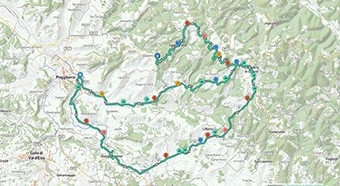
<iframe src="https://plugin.routeyou.com/poiviewer/free/?language=fr&params.poi.id=9026129&params.language=en" width="100%" height="600" frameborder="0" allowfullscreen></iframe>

Plus de 10 100 000 itinéraires

Plus de 15 000 000 d'utilisateurs

Plus de 4 500 000 points d'intérêts

Kerkstraat 108
9050 Gentbrugge, Belgique
Contactez notre équipe de support client ou visitez notre centre d'aide.
© 2006-2025 RouteYou - www.routeyou.com