The summit is named after its shape, which resembles a head with a fez on it, a type of headgear that was commonly worn during the first ascent of the summit in 1905 in the then Ottoman Empire and thus was associated with Turks in Central Europe.
Unlike the widely visible valley guardian, the neighboring Turk's Head is hardly recognizable from Rathen, as it does not stand out from the field stones and honey stones behind it. With a maximum wall height of 45 meters on the valley side, it is slightly smaller than the valley guardian and the directly adjacent eastern field peak, where the height in the mountain-side notch is only 20 to 25 meters. The distinctive shape of the summit top, which rests on a broad base, is only clearly visible from close up or from a viewpoint above the summit.
Source: Wikipedia.org
Droits d'auteur: Creative Commons 3.0
 | | Public | Italien • allemand • danois • espagnol • français • néerlandais

Sélectionnez l'une des activités les plus populaires ci-dessous ou affinez votre recherche
Découvrez les plus beaux et les plus populaires itinéraires du secteur, soigneusement regroupés dans des sélections appropriées.
Sélectionnez l'une des catégories les plus populaires ci-dessous ou inspirez-vous de nos sélections
Découvrez les plus beaux et les plus populaires points d'intérêt du secteur, soigneusement regroupés dans des sélections appropriées.
Avec RouteYou, vous pouvez facilement créer vos propres cartes personnalisées. Tracez votre itinéraire, ajoutez des points de passage ou des points-nœuds, planifiez des points d'intérêt et des lieux de restauration, et partagez le tout avec votre famille et vos amis.
Planificateur d'itinéraire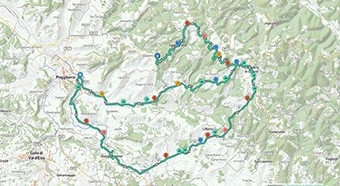
<iframe src="https://plugin.routeyou.com/poiviewer/free/?language=fr&params.poi.id=7587339&params.language=en" width="100%" height="600" frameborder="0" allowfullscreen></iframe>

Plus de 10 100 000 itinéraires

Plus de 15 000 000 d'utilisateurs

Plus de 4 500 000 points d'intérêts

Kerkstraat 108
9050 Gentbrugge, Belgique
Contactez notre équipe de support client ou visitez notre centre d'aide.
© 2006-2026 RouteYou - www.routeyou.com