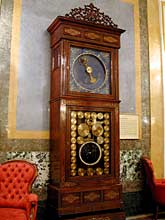
Billeter Astronomical Clock in the Congress of Deputies.
Introduction:
In the late 19th century, with the growth of Gràcia, Can Pardal's owners decided to urbanize their land and tear down their farmhouse to build the building we see today, with a portico and a clock tower with bells. It seems however, that before being torn down, the farmhouse housed a famous person: Albert Billeter, a Swiss watchmaker, installed in Gràcia for almost thirty years.
Content:
"Factory of tower clocks for churches, railroads, factories and cottages. Surveillance watches, electric telegraphs and scientific equipment" was the name used by Swiss Albert Billeter to announce his establishment. Billeter had left La Chaux-de-Fonds in Switzerland, where he had studied watchmaking, passing through Italy and ending up in the Town of Gràcia. The first thing he did upon arrival was to develop a large astronomical clock showing the movement of the earth and the moon in relation to the sun. It gave the local time and and the time at 20 other meridians, among other data. Billeter sent a letter to the Congress of Deputies in Madrid in which he highlight the need for developing a national watchmaking factory so that Spain would not depend on foreign industry and he offered his astronomical clock in exchange for a sum money which would allow him to open a permanent workshop. Congress bought the clock, which still works and it is in the Palace of Congress. Immediately afterwards, the Senate commissioned Billeter to make an even bigger astronomical clock. Billeter took almost ten years to do it, and with the political upheavals of the time, the Senate disowned the project and nobody bought the clock. Eventually, it found its way into the hands of a family of carpenters, the Moragues, who were the craftsman of clock furniture. When Billeter was no longer in Barcelona the clock was exhibited at the Palace of Sciences during the Universal Exhibition of 1888, where it won a gold medal. Later, it was acquired by the Barcelona Royal Academy of Sciences and Arts, which still owns it. Billeter was also the creator of the Gràcia bell tower clock, which was changed in 1929 when it was transferred to the hotel at Plaça Espanya which served as the entrance to the Universal Exhibition of that year. In 1952, the clock was removed from the hotel and since then nobody knows where is it. In 1865, Billeter also built the clock for the Barcelona Cathedral, which still runs to this day.
More Information:
Eduard Farré Olivé (1996): Alberto Billeter, un relojero suizo en Barcelona. (1ª part) "Arte y Hora" n. 121-H/4, Nov-Dic, p. 12-18. (2ª part) "Arte y Hora" n. 122H5, Ene-Feb 1997, p. 6-11. [in Spanish]