Risorsa: Jan Rymenams


Location
Lierneux is situated at an elevation of 420 meters above sea level. The village is near the sources of the Lienne river, which flows north from Lierneux to join the Amblève near Targnon. The municipality has over 3000 inhabitants. It consists of the districts of Lierneux, Bra, and Arbrefontaine.
Like Geel (Antwerp province), Lierneux has had a psychiatric institution for over a century, the specialized hospital center "Accueil" (CHS).
Lierneux features ski slopes, cross-country ski trails, and a toboggan run. This small ski area, known as “Le Monty,” was established in the 1980s by André Remacle, a former municipal manager.
The municipality of Lierneux is traversed by the GR 14, a long-distance hiking trail that connects Paris (Île-de-France) with Malmedy (Belgium), and by the GR 571, also known as the circuit des vallées de légendes, which runs through the valleys of the Amblève, the Salm, and the Lienne.
Lierneux is a member of the Groupement Régional Économique des Vallées de l'Ourthe, de la Vesdre et de l'Amblève (GREOVA) and the Maison du tourisme du Pays d'Ourthe-Amblève.
History
The name Lierneux is believed to mean 'place by the bubbling river'.
Symètre, the saint closely associated with the history of the original parish of Lierneux, was martyred in Rome in 159. Some authors have attributed his birth to Lierneux and claimed that he was the son of a wealthy Gallo-Roman landowner, but these are undoubtedly apocryphal stories intended to embellish reality.
At the end of the 7th century, the relics of the Roman martyr were likely donated to the church of Lierneux by Bishop Babolin, abbot of Stavelot, of which he is said to have been the founder.
The first mention of the church of Lierneux dates back to 862. A chapel - cum capello - is mentioned as belonging to the Lierneux estate villa nuncupante lernou.
The discovery in 1974 of a piece of worked flint at the medieval site of Ecdoval (on the edge of Bois de Groumont in Lierneux) should make us consider the possibility of such settlements in the Neolithic. Furthermore, excavations in 1976 at the fortifications of Gros-Thiers in Salmchâteau unearthed the existence of a site from the Late Iron Age (between 470 and the beginning of our era).
In the Merovingian period, Lierneux-Bihain was the seat of a royal villa and a tax office. There are even mentions—though we would be more cautious—of a Frankish burial site discovered in 1904 not far from the village of Bihain. Nonetheless, in 1849, part of a golden floor belonging to one of the Merovingian kings was discovered on the territory of this municipality.
Around the mid-7th century, Sigebert III, king of Austrasia (633-656), granted Saint-Remacle a territory roughly corresponding to the watersheds of the Warche and the Amblève. In 670, Childeric II, king of Austrasia, confirmed Sigebert's donation but stripped the abbey of Stavelot of the Lierneux estate. In 747, Carloman, mayor of the palace, under the reign of Childeric III (743-751), returned the village of Lierneux to Anglinus, abbot of Stavelot-Malmedy.
In 862, King Lotharius II reaffirmed the estate of Lierneux, describing it as consisting of 46 manors, a chapel, and a lordship.
Lierneux, like the rest of Stavelot, struggled to recover from the Norman invasion of 883.
In 1130, the church of Lierneux fell under the jurisdiction of Stavelot and owed the abbey a cartload of wine.
From that moment on, the chapters of Stavelot and Malmedy had plenty of opportunities to dispute the primacy of the principality. The conflict, which was inextricably linked to the history of the principality until its disappearance in 1794, reached a climax in 1071. On that day, Emperor Henry IV united the two monasteries under the leadership of the same abbot, giving Stavelot the upper hand. In memory of this day, the parishioners of Lierneux and Ottré would annually process to Stavelot on May 9 to accompany the relics of Saint-Symètre. In 1696, at least one person per household was required to accompany the procession. It was a picturesque procession in which fiddle players mingled with the pilgrims and for which the mambours of the church of Lierneux paid a barrel of beer that the pilgrims drank at the stop in Trois-Ponts.
The 17th century was undoubtedly a ruthless time. Troops continuously moved across the territory of the neutral principality. The list of armies would be too long to detail, but let's say they gradually decreased during the first decades of the 18th century, with a short resurgence during the Seven Years' War between France and Austria and Prussia. In 1759, the Saint-Aldegonde regiment was quartered in Lierneux.
A long period of calm followed, which was only interrupted by the arrival of Republican troops. In 1826, the municipal council of Lierneux passed regulations that were worthy of the old prince-abbots. Cabarets had to close in winter at 9 PM and in summer at 10 PM. The closing time was announced by the bells of the church of Lierneux and it was expressly forbidden for cabaret owners to serve customers during church services.
Of course, the 19th century was heavily influenced by major events: the revolution, machine technology, the parliamentary system, but it was still a time of notables. Of the 2033 inhabitants of Lierneux in 1845, 88 had voting rights in municipal elections, 12 in provincial elections, and 11 in parliamentary elections.
Risorsa: Gemeente Lierneux
 | | Pubblica | Danese • Francese • Italiano • Olandese • Spagnolo • Tedesco

Seleziona una delle attività più popolari qui sotto oppure affina la ricerca.
Scopri gli itinerari più belli e popolari della zona, accuratamente raggruppati in apposite selezioni.
Risorsa: Jan Rymenams
Seleziona una delle categorie più popolari qui sotto o lasciati ispirare dalla nostra selezione.
Scopri i luoghi di interesse più belli e popolari della zona, accuratamente raggruppati in apposite selezioni.
Risorsa: Jan Rymenams
Con RouteYou puoi creare facilmente mappe personalizzate. Traccia il tuo itinerario, aggiungi waypoint o nodi, luoghi di interesse e di ristoro, e condividi le mappe con la tua famiglia e i tuoi amici.
Pianificatore di itinerari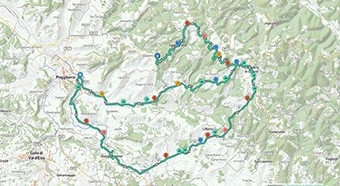
<iframe src="https://plugin.routeyou.com/poiviewer/free/?language=it&params.poi.id=8772879&params.language=en" width="100%" height="600" frameborder="0" allowfullscreen></iframe>

Più di 11.800.000 itinerari

Più di 15.000.000 utenti

Più di 4.500.000 luoghi d'interesse

Kerkstraat 108
9050 Gentbrugge, Belgio
© 2006-2026 RouteYou - www.routeyou.com