Bron: Mentens, Jeroen, 18-03-2009, ©Ranaphoto
Auteursrechten: All rights reserved


Spegelsweg nr. 3. "Castle of Oostkerke," a beautiful castle estate bordering the southern edge of the village center of Oostkerke. The castle is the historical residence of the Lords of Oostkerke, characterized by an upper court-lower court structure. The remains of the medieval outbuildings were transformed in the 19th and 20th centuries into a large, picturesque villa. In the mid-20th century, the van der Elst family redesigned the surroundings of the castle into a beautiful architectural castle garden. The designs were created by the internationally respected Dutch landscape architect Mien Ruys (1904-1999).
History. The first written mention of the family "van Oostkerke" is found in a document from 1089, which lists Dodinus van Oostkerke as a witness to the donation of tithes located in the parish of Oostkerke, by the Count of Flanders to the St. Quentin Abbey in Vermandois. This noble family resided in Oostkerke; archaeological research indicates that there was building on the site from the 10th-11th century, possibly a wooden residential tower. It is likely that the church of Oostkerke was built around 1100 on lands that belonged to the possessions of the Lords of Oostkerke. The Lords of Oostkerke had possessions in the region of Oostkerke, Damme, and Moerkerke extending to the count's estate of Mechelen. The family likely owned a closed estate between Oostkerke and Sijsele, with Spegelsweg connecting the different domains.
In the 13th century, these were: the estate in Oostkerke, with a brick donjon on a rectangular plan, characterized as a defensive fort along the Zwin; the Spermalie estate in Sijsele, owned by Willem van Oostkerke until 1228; and the Bonem estate between Damme and Vivenkapelle, which was acquired in 1247. In the 14th century, they owned the village mill in Oostkerke, and in the 14th and 15th centuries, additional lands were added in the heirlooms of the Ghent St. Peter's Abbey in Oostkerke. "Den Hove van Oostkerke" is first mentioned in 1358 in a charter in which Katelijne, daughter of Louis van Oostkerke, donates 10 meteres of land in the vicinity of the court to the Magdalena Godshuis in Bruges.
At the court of Oostkerke, the family built a new residence in the 14th century, surrounded by walls and towers made of brick: an upper court-lower court structure arose. This aligns with the general trend occurring from the 13th century, in which the donjons or residential towers were abandoned in favor of larger, more comfortable buildings within strong defensive walls. Around the donjon, a trapezium-shaped lower court was constructed, with an upper court to the south. The upper court is rectangular, measuring approximately 47 meters by 24 meters. The three towers are located at the western corners and at the southeast corner, with a diameter of 5.20 meters. The new residence of the Lords of Oostkerke is likely situated in the northeast corner, the corner without a tower. Outside the ring wall is a moat about ten meters wide. The upper court is connected to the lower court by a yet-to-be-located bridge.
In the northwest corner of the lower court stands a round dovecote. The entrance to the lower court is located in the northeast corner and was flanked by two round towers, with an ice cellar located under the eastern tower. These monumental towers still define the entrance to the estate. To the west of the court of Oostkerke, there was an accompanying sheep farm in the 14th century.
15th century - The last descendant of the family, Margriet van Oostkerke, dies in 1462. The Hof van Oostkerke passes into the hands of the heirs, the family de Fever-de Baenst. On the map of the Zwin region from 1501, the castle is depicted very unclearly. A description from that year in the feudal register of the Burg of Bruges mentions: "Antionine Widow of Jacques d’Archies holds the court at Oostkercke and is large about 10 meteres of land with houses and trees that stand up, with upper court, lower court, moats, singles and orchards belonging to it." A description in the water management report from 1517 states that the buildings are partially in disrepair. This is likely due to the prevailing religious troubles at the time.
The sheep farm also fell into disrepair and was replaced in the early 16th century by a tenant farm on the east side of the Spegelsweg. The map of Pieter Pourbus from 1561-1571 shows that the enclosures and dovecote have disappeared; the donjon has been partially preserved. The family de Croy inherits the castle property of Oostkerke in 1579. This family does not reside in the castle. Furthermore, because the region suffers from religious turmoil and in 1606 a severe storm occurs, it can be concluded that at the beginning of the 17th century, the castle was in a state of disrepair, which can be confirmed by archive documents. In 1623, the castle came into the possession of the family de Corte. Philips de Corte likely undertook several renovations on the castle, cf. the basket-arched entrance gate, the entrance door, and the southern window on the first floor of the western tower, all decorated with sandstone corners and architectural style referring to the Bruges renaissance around 1630. The dovecote is rebuilt.
18th century - The castle on the upper court is demolished around 1700. On a map from 1765, the composition of the Hof van Oostkerke is clearly visible: the buildings of the estate are all located on the lower court (at the current site of the buildings) and are referred to as "castle"; the upper court is occupied by a large orchard, and both courts are surrounded by a moat; to the right of the entrance, a dwelling for a gardener or housekeeper. Other late 18th-century maps show the garden on the lower court, to the west of the buildings, in more detail: the rectangular garden is divided into four by two right-angled paths and is walled off on the eastern side by a wall separating it from the courtyard next to the dwelling. A sketch map in the Mestdagh collection depicts the late 18th-century layout of the building into different rooms.
19th century - The castle estate of Oostkerke is publicly sold by the French Republic in 1799 and repurchased by the wife of the previous owner. Through marriage, it comes into the family of Zuylen de Nyevelt Gaesbeek. This family has to publicly sell the estate in 1838 due to lack of capital. Franciscus Mabesoone, a farmer and mayor in Oostkerke, purchases the property. The deed of sale contains a clear description of the then state: "67 a 90 ca being the moeshof and basse-cour where the castle stands with carriage house and stables, entering over a stone bridge with large gate, having on both sides a small tower pointing northward right across from the church of Oostkerke, on the west side of which is the farmer's house, as well as in the northwest corner of the moeshof a tower or dovecote, all built in stone and covered with slates, tiles and bricks, surrounded and strengthened with stone kayen." The family leases the estate as an agricultural operation. The widow Mabesoone lets Bernard Mestdagh live in the castle, a retired teacher from Oostkerke. He receives permission in 1854 to build a stone windmill north of the estate, against the Zuidbroekstraat, now known as the "Old Mill" (cf. Spegelsweg z.nr./Zuidbroekstraat).
Mabesoone's son carries out extensive renovations on the castle in 1884: he converts the southern part of the wing along the Spegelsweg into a cow shed and fills in the moat around the upper and lower courts; the dovecote is demolished. The western entrance tower is used as a beet storage facility; the gardener's cottage serves as an oven and rabbit hutch. During the time the castle is in the hands of the Mabesoone family, it is very dilapidated. In 1908, Mabesoone sells the estate to Robert Van der Borght from Ukkel.
First quarter of the 20th century - The new owner Van der Borght comes to live in the castle and has two restoration phases carried out. In the first restoration phase shortly after his purchase, he has the buildings whitewashed and fully furnished the house. He buys recovery materials to furnish the castle, including a gothic fireplace from the Sint-Jan house in Bruges, a water well in the courtyard, and a large bluestone table. The castle is completely looted and vandalized during World War I, forcing Van der Borght to carry out a second major restoration phase in 1922. The buildings are largely rebuilt on the existing foundations and are not repainted white. The interior layout is modified: small salon, dining area, and staircase hall take their current form. All rebuilt door openings are Tudor arched. The gothic fireplace is destroyed; three other antique fireplaces are installed. The gardener's cottage is converted into a garage, a gazebo is built in the garden, and a ratel poplar is planted in the inner courtyard, which still exists. In front of the entrance gate, two bluestone lions, above them a wooden coat of arms. In 1927, the castle is sold to Martha Barbé.
Interwar period - The new owner buys back the castle meadow, allowing her to extend the western wing of the buildings with a large building including two garages accessible from the north side, above which is a large hall. The wide entrance gate is bricked up on the garden side, with a door and a window that still exist. In 1937, Mrs. Barbé sells the estate (castle and meadow) to Baron Jo van der Elst, ambassador of Belgium in Vienna.
1937 - present: Family van der Elst. Baron Joseph van der Elst takes care of the further expansion of the buildings of the historical lower court into a picturesque, comfortable residence. At the initiative of his wife Allison Campbell Roebling, the castle garden, together with the former upper court and the surrounding lands, is redesigned into a beautiful castle garden. The internationally renowned Dutch landscape architect Mien Ruys (1904-1999) is commissioned for the designs. The large western expansion built by the previous owner is replaced by a building in neo-Renaissance style, with a stepped gable, designed by Luc Viérin (Brugge). The buildings are equipped with central heating, plumbing, and electricity. The moats are dug out, and the access bridge is restored. The remains of the defensive walls of the upper and lower courts are rebuilt and used in Mien Ruys's garden design. However, the efforts are undone by World War II: shelling and a strategic flooding of the surroundings cause severe damage to the buildings and garden. In the 1950s, the buildings and the garden are completely restored. In 1950, a salon is added to the wing along the Spegelsweg, designed by architect Luc Viérin (Brugge). Baron van der Elst buys the surrounding grounds and the Old Mill; these play an important role in the new garden design by Mien Ruys. The vegetation damaged by the flooding, such as mulberry hedges, pollard willows, and poplars, is replanted.
Description. The estate of the Castle of Oostkerke is located southwest of the village center of Oostkerke. It is a rectangular estate, bordered to the north by the Zuidbroekstraat and to the east by the Spegelsweg. It includes the parcels of the moated upper court and lower court of the castle, supplemented by several surrounding meadows and the so-called "Old Mill" of Oostkerke. These lands were purchased by Baron Joseph van der Elst for the purpose of creating a large-scale castle garden by landscape architect Mien Ruys. The entire estate is bordered with mulberry hedges and long rows of pollard willows and poplars.
CASTLE The current castle is located in the northeastern corner of the former lower court. It consists of the monumental 14th-century gatehouse with the two flanking round towers, behind which are two wings arranged in an L-shape, dating back to the core 14th-century farm buildings (along Spegelsweg) and the minimally 18th-century gardener’s house (at the western tower). These buildings have been adapted over the centuries as a residence, instead of the demolished original castle that stood on the smaller upper court located to the south. In the mid-20th century, both wings were equipped with all modern living comforts and extended with new expansions designed by architect Viérin.
The two monumental round towers flanking the entrance have a diameter of 4.40 meters. They are constructed of light red bricks of different sizes, the walls are 80 cm thick, and they are capped with slate tent roofs. The original material consists of moeffen, which have been supplemented and rebuilt with recovery materials over the centuries due to various damages. The western tower was partially rebuilt in 1922. The brick size of 22.5 cm in length is the most common. Each tower has three shooting holes with neg blocks of Balegem sandstones, round holes in the middle, and half-round at the bottom. The windows with the same neg blocks have been renewed; the windows with an intermediate sill are equipped with a relieving arch. Between the towers is a three-meter-wide entrance arch; the current entrance and the cantilevered floor above the old entrance date from 1922. Of the bridge, the arch support against the building and part of the center pillar have been preserved. On the parapet of the bridge are two crouched lions, blue natural stone, 97 cm high, mid-18th century; originating from a house in Bruges.
The eastern side wing contains salons; constructed from red brick under red tiled gable roofs with dormer windows. The garden facade is painted white. Against the eastern tower, in 1922, a gallery was built before the old side wing along the Spegelsweg, for which a shooting hole was partially bricked up. A portion of the side wall of the old wing along the Spegelsweg has been preserved, including part with three small buttresses. In 1922 these walls were raised and used as the east wall for the largely newly built wing, erected on old foundations on the west side. This wing was supplemented in 1950 with a wide salon under a perpendicular gable roof, in matching neo-Renaissance style, featuring a large window in the gable end overlooking a terrace. Wooden windows, in the older wing with wooden cross frames and shutters, Tudor arch doors.
Against the western tower is a wing that has been built on the former gardener’s house. Two small windows (neg and light red brick) with relieving arches are still visible on the now bricked-up cellar floor; the ground floor of the wing was rebuilt in 1922. The attached part from the 1930s with a large hall on two garages was replaced during renovations in 1938-1939 by a low brick building under a slate gable roof with dormer windows and a high brick chimney with a worked-out chimney head. The western side gable, designed as a stepped gable, the door under a wooden canopy, and the recovered neo-Gothic window give this part of the building a picturesque character. Furthermore, rectangular windows with stone frames.
The interior of the castle contains, in addition to some old elements like the black natural stone floors, recovery elements introduced during the 20th-century restoration phases such as fireplaces. A romantic, historicist interior design was chosen, aligning with the overall atmosphere of the building on this historic location.
GARDEN For the design of the garden around the castle, the Dutch landscape architect Mien Ruys (1904-1999) was commissioned. Already in 1938-1939, drawings and ideas were exchanged. However, the previously made plantings were destroyed by the artificial, military-strategic flooding in 1944. Detailed working drawings for replanting the garden followed in 1946-1947, executed in the early 1950s. The garden is a beautiful example of the new ideas in landscape architecture that Mien Ruys developed, based on the use of plants suitable for the soil conditions in situ, using perennial plant borders as the basis for the design, starting from the essence of the available space and the possibilities of the place, incorporating elements like train sleepers, etc. The strength of the castle garden lies primarily in the perfect harmony with, and the perfect transition to the pristine surrounding polder landscape with its typical elements like pollard willow rows, ditches, and mulberry hedges, its church tower in the nearby village, and the old mill's ruins.
The existing historical environmental elements are used as landmarks for the garden's design. Previous owners have already made initial efforts to structure the space around the buildings. To the west of the building, a brick wall was built in the 18th century to separate an inner courtyard from a lower-lying garden. In that inner garden, the early 20th-century owner Van der Borgt had a ratel poplar planted. The upper court and the lower court, of which Baron van der Elst has the moats restored immediately after the purchase of the estate, were shielded by a ring wall in the 14th century. Both elements are integrated into the design. At the initiative of Mien Ruys, efforts are made to search for and rebuild wall remnants with moeffen up to the ground floor level, including the circular foundations of the corner towers of the upper court and the dovecote at the northwest corner of the lower court. These structures are used as walking paths, leading the garden visitor through the different entities within the garden design. Baron van der Elst purchased the meadows surrounding the estate in the 1940s, including the parcels to the north of the castle, up to the Zuidbroekstraat. He also acquired the "Old Mill"; this mill from 1854 lost its function as early as 1889 and by the mid-20th century exists as a whitewashed, stripped-down shell of a mill without any interior. The mill takes on the role of a lookout tower and a luxurious garden pavilion within the garden, with the roof finishing as a terrace and the incorporation of new floor levels with the installation of a fireplace on each level. The mill is connected to the lower court by a monumental row of poplars, creating an exceptionally strong perspective effect.
The core of the garden design is the garden located on the original upper and lower court, southwest of the current residence. Closed gardens form a plant bastion around the house, at the same level. They are shielded by yew hedges that after fifty years form a significantly thick wall. In the angle of the two perpendicular wings, there is a walled inner garden with a ratel poplar and a centrally positioned natural stone water well. This inner courtyard is bordered by a thick yew hedge. When descending the western staircase, on the left is the summer border, composed of
Bron: Callaert, Gonda & Hooft, Elise
Auteursrechten: All rights reserved
 | | Publiek | Deens • Duits • Frans • Italiaans • Nederlands • Spaans
Adres: Spegelsweg 3, Damme
Statistieken
Selecteer hieronder één van de populairste activiteiten of verfijn je zoekopdracht.
Ontdek de mooiste en meest populaire routes in de buurt, zorgvuldig gebundeld in passende selecties.
Bron: Mentens, Jeroen, 18-03-2009, ©Ranaphoto
Auteursrechten: All rights reserved
Selecteer hieronder één van de populairste categorieën of laat je inspireren door onze selecties.
Ontdek de mooiste en meest populaire bezienswaardigheden in de buurt, zorgvuldig gebundeld in passende selecties.
Bron: Mentens, Jeroen, 18-03-2009, ©Ranaphoto
Auteursrechten: All rights reserved
Met RouteYou kan je eenvoudig zelf aangepaste kaarten maken. Stippel je route uit, voeg waypoints of knooppunten toe, plan bezienswaardigheden en eet- en drinkgelegenheden in en deel alles met je familie en vrienden.
Routeplanner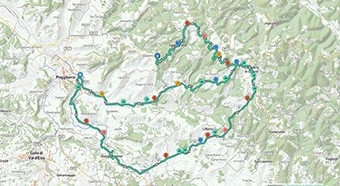
<iframe src="https://plugin.routeyou.com/poiviewer/free/?language=nl&params.poi.id=3199039&params.language=en" width="100%" height="600" frameborder="0" allowfullscreen></iframe>

Meer dan 11.800.000 routes

Meer dan 15.000.000 gebruikers

Meer dan 4.500.000 trekpleisters

Kerkstraat 108
9050 Gentbrugge, België
© 2006-2026 RouteYou - www.routeyou.com