The site of the old quarries of Opprebais
Rue de la Bruyère 1315 INCOURT
The exploitation of the quarry
The quartzite of Opprebais has been locally exploited since the Middle Ages, its extraction intensified due to the construction of new roads, such as the Namur-Louvain axis created around 1755 under the impetus of Empress Maria Theresa of Austria. Almost abandoned during the French and Dutch periods of Belgium, large-scale exploitation of the quartzite quarries did not truly resume until after the declaration of independence in 1830. Indeed, significant subsidies granted by the Province of Brabant to municipalities for road paving allowed for an initial industrial boom. Initially interested in the exposed rocks, operators were required to backfill the excavated areas until the 1870s. From this time on, open-air excavations like this one left marks on the landscape. By 1894, the Opprebais quarry already employed nearly 50 workers and held a monopoly on exploitation. Until the eve of World War I, the quartzite quarries experienced exceptional expansion and even extended their product range: cobblestones, rubble, and stones. Between the 1920s and 1930s, the Opprebais quarries ceased their activities. They were flooded in 1935, but exploitation resumed in 1958 and ceased permanently in 1975. In the 1990s, the Commune of Incourt purchased the industrial wastelands surrounding the flooded quarry. The site has since been transformed into a friendly rural area consisting of a center for intergenerational housing, a House of Nature, recreational areas, and a nature-discovery path around the pond.
The quartzite, descriptions, modes of exploitation, and first uses
The quartzite known as "d'Opprebais" or Dévilien quartzite, which actually results from the recrystallization of sedimentary sandstone, has been extracted since the Middle Ages. It primarily comes from the subsoils of the villages of Dongelberg, Opprebais, and Blanmont. This rock appears in the form of thick benches several meters long, often traversed by faults filled with water. Because quartzite is an extremely hard rock, explosives were commonly used to detach rock faces, and for the same reason, fine shaping of quartzite was also impossible. The extraction and use of this material as building stone are relatively old, as evidenced by the exceptional keepsake-porch of the Opprebais farm-castle dating back to the 18th century. Nevertheless, it is little present in local architecture, aside from a few foundations, with the quartzite of Opprebais primarily being exploited for the production of cobblestones.
Kilde: Tourisme Hesbaye brabançonne
 | | Offentlig | Dansk • Fransk • Italiensk • Nederlandsk • Tysk • spansk
Adresse: 1315 incourt
Statistikker
Vælg en af de mest populære aktiviteter nedenfor, eller forfin din søgning.
Oplev de smukkeste og mest populære ruter i nærheden, omhyggeligt samlet i passende udvalg.
Vælg en af de mest populære kategorier nedenfor, eller lad dig inspirere af vores udvalg.
Oplev de smukkeste og mest populære seværdigheder i nærheden, omhyggeligt samlet i passende udvalg.
Med RouteYou kan du nemt selv lave tilpassede kort. Planlæg din rute, tilføj waypoints eller knudepunkter, planlæg seværdigheder og spise- og drikkesteder og del alt med din familie og venner.
Ruteplanlægger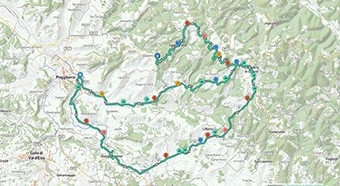

<iframe src="https://plugin.routeyou.com/poiviewer/free/?language=da&params.poi.id=1445596&params.language=en" width="100%" height="600" frameborder="0" allowfullscreen></iframe>

Mere end 11,800,000 ruter

Mere end 15.000.000 brugere

Mere end 4.500.000 seværdigheder

Kerkstraat 108
9050 Gentbrugge, Belgien
© 2006-2026 RouteYou - www.routeyou.com