Font: Perplexity - Pascal Brackman


Fritz Haber is often called the father of gas warfare because he initiated and led the first major chlorine gas attack at Ypres in April 1915. Fritz Haber was a German-Jewish chemist who both revolutionized agriculture and played a central role in introducing poison gas as a weapon in World War I.
On April 22, 1915 , north of Ypres, between Steenstrate and Langemark, the Germans carried out the first large-scale, successful gas attack, using approximately 150 tons of chlorine gas from thousands of buried cylinders.
Haber, along with Carl Bosch, developed the Haber-Bosch process , which synthetically converted atmospheric nitrogen into ammonia for use in fertilizers and explosives . For this work, he received the Nobel Prize in Chemistry after the war (awarded in 1920 for work before 1914), even though his role in gas warfare was already being heavily criticized.
At the outbreak of World War I, Haber offered his expertise to the German army, convinced that new chemical weapons could force a rapid breakthrough at the front. His wife, Clara Immerwahr, disagreed with his approach. Clara Immerwahr was a chemist herself, the first woman to hold a doctorate in chemistry in Breslau, and she was morally opposed to the use of chemical knowledge for mass destruction. In later accounts, she is quoted as calling Haber's gas work a "perversion of science" and a form of barbarism, suggesting a fundamental ethical disagreement with her husband.
After the war, he remained active in the chemical warfare and poison gas field, and the Kaiser Wilhelm Institute, which he led, became a center for research into poison gases and pesticides. His research on cyanides and delousing agents formed the basis for the pesticide Zyklon (later called Zyklon A ), a cyanide product for pest control. Based on research originating from Haber's institutes, Degesch, a state-controlled pesticide consortium, was founded in 1919, which developed cyanide preparations such as Zyklon. In the early 1920s, chemists such as Walter Heerdt, Bruno Tesch, and Gerhard Peters developed the new pesticide Zyklon B (hydrogen cyanide on a carrier, with a warning substance) and patented it in 1926; this was based on earlier cyanide and pesticide research, but no longer by Haber himself. Historians formulate it this way: Haber's research formed "one of the foundations" for Zyklon B, but that he did not directly contribute to the actual formulation or packaging. Haber died in 1934, almost ten years before the systematic use of Zyklon B in the gas chambers from 1941–1942.
 | | Pública | Neerlandès

Seleccioneu una de les activitats més populars a continuació o perfeccioneu la cerca.
Descobriu les rutes més boniques i conegudes de la zona, acuradament agrupades en seleccions adequades.
Font: Perplexity - Pascal Brackman
Seleccioneu una de les categories més populars a continuació o inspira't en les nostres seleccions.
Descobriu els llocs d'interès més bonics i coneguts de la zona, acuradament agrupats en seleccions adequades.
Font: Perplexity - Pascal Brackman
Amb RouteYou pots crear mapes personalitzats molt fàcilment. Defineix la teva ruta, afegeix waypoints o interseccions, planifica parades a punts d'interès o a establiments per menjar i beure i comparteix-ho tot amb els amics i la família.
Planificador de rutes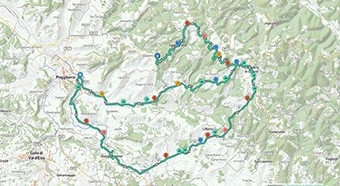

<iframe src="https://plugin.routeyou.com/poiviewer/free/?language=ca&params.poi.id=9368110&params.language=en" width="100%" height="600" frameborder="0" allowfullscreen></iframe>

Més de 11.800.000 rutes

Més de 15.000.000 usuaris

Més de 4.500.000 llocs d'interès

Kerkstraat 108
9050 Gentbrugge, Bèlgica
Contacteu amb el nostre equip d'atenció al client o visiteu el nostre centre d'ajuda.
© 2006-2026 RouteYou - www.routeyou.com