Source: Vlaamse Gemeenschap, 25-08-2000, ©Vlaamse Gemeenschap
Copyright: All rights reserved


* So-called castle of Lilare, also sometimes called "castle Norman" or "castle of Oudenhove"; The current St. Francis Institute includes a lyceum with boarding school, free primary school and mother monastery of the sisters of the Congregation of St. Francis of Opbrakel. Historic castle domain located east next to the Zwalmbeek, going back to the lordship of Lilare, which, as the most important of the six lordships within the parish of Sint-Maria-Oudenhove, had its own four shears and the three degrees of justice. Little is known with certainty about the history of the castle site and much information is still missing about the later construction evolution. Already in the 12th century there are lords with the name of Lilaere known but no demonstrable evidence that they were also lords of the eponymous estate at Sint-Maria-Oudenhove. At least since the first half of the 15th century, the van Herzele family is said to have been in possession of the lordship of Lilare. On map of the Land of Aalst of 15(9)6 by J. Horenhault indicated as a moat site called "t hof ten Broucke"; according to a mention of 1539, "thof ten broucke" was then a tenant farm of one of Herzele, lord of Lilare. On map in A. Sanderus Flandria Illustrata of 1644 referred to as "'t casteel ten Broucke". In 1657 the lordship of Lilare and the water castle were sold by the Rodoans, descendants of the van Herzeles, to knight Pieter Blondel. After it was ravaged by fire around 1667, it was rebuilt in the second half of the 17th century by Pieter Blondel, from 1675 baron of Sint-Maria-Oudenhove. From 1756 to 1810 in the possession of the de Norman family. On the Ferraris map (1771-1778) referred to as "chateau de Lilaers" with castle within a moat spacious rectangular park with characteristic geometric layout. In the first half of the 19th century owned / inhabited by the Maes-Mathot family; sold to Vermeulen circa 1850; afterwards inherited by Count Mizaël le Mesre de Pas; remained in the possession of the same family as a country residence until 1933. Purchased in 1933 by the sisters of Saint Francis van Opbrakel who first housed a rest home and since 1938 a girls' school with boarding school. A 120-metre-long straight entrance drive, bordered by linden trees and a chestnut, leads from the N. to a moat, deep rectangular castle park; gatehouse and castle in the axis of the entrance drive with two profiled hard stone postaments on the street crowned by ornamental vase with garlands. * Gatehouse from the 17th century behind the brick bridge over the northern castle moat; Brick bridge railings recently replaced by iron railings. The central entrance gate with flanking towers and side wings, used as a farm until the late 1950s, has since housed the central administration and general economate of the Congregation of the Sisters of Saint Francis of Opbrakel. Restored in the early 1990s to a design by architect L. Sledsens and D. Baston with replacement of a lot of natural stone and woodwork; both transverse wings partially modified and some of the spaces inside completely renewed. Two-storey brick and sandstone gatehouse, covered by steep hipped roof (slates) crossing on wooden modillons. Central driveway on both sides with basket arch gate encased in checkered frame. Façade (north-facing) enriched with corner chains and regular layers of bacon, weathered year stone and sculpted coat of arms of Blondel-de Blondel. Centrally curved top window below ditto, stepped roof window. Rear façade, on the other hand, has two small rectangular upper windows (frames with ears together with former kalei layer removed from the entire gatehouse); Elevated central wall dam with braids and chimney. Year 1755 and inscription IBI on left wing of entrance gate in façade; 1993 on renewed part of it referring to restoration. Composite beam layer in drive-through; preserved attic trusses and interior doors. Both square flanking towers of three storeys under tent roof with onion-shaped crown (slates), stylized in shape since restoration. Former cell in the substructure of the west flanking tower: year 1684 decorated in iron outer cladding of lowered door in driveway, interior renewed floor and vault. Wooden spiral staircase preserved in east flanking tower. West wing of four bays, perpendicular to the south and partly behind the west flanking turret; two first bays with baking oven strongly renewed. Next three bays under steep slate gable roof between stepped gables, from 1878. Neo-Gothic stepped gable (south) with year stone 1878, referring to the year of construction and restoration of the gatehouse by then owner Mizaël le Mesre de Pas. Wide east wing of brick and mostly replaced sandstone, perpendicular to the south and partly behind the east flanking turret; two storeys under hipped roof (slates). Former farmhouse of which upper floor used as hayloft. Three basket arches on the ground floor of south frame façade fully opened during the restoration; central spout-shaped roof window removed. Retained curved door in frame in east façade. Modernized woodwork and heavily modified interior design; a preserved nut beam on sandstone console on ground floor. To the east, next to and parallel to the northern moat: low former stables; In the south façade preserved old gate and door. Perhaps modified along with the enlargement to the east in the 1930s. Parallel opposite: former cross barn under tiled gable roof; mostly renewed wooden construction adapted into a garage. Castle. According to some authors, the castle, rebuilt in the second half of the 17th century under the Norman family, was again destroyed by fire and therefore rebuilt in the second half of the 18th century or circa 1800; however, probably around 1850 or early of the third quarter of the 19th century by the Vermeulen family virtually rebuilt (see initials A V van Vermeulen in the iron parapet of the landing staircase in front of the entrance next to interior elements with stylistic features typical of the third quarter of the 19th century). Expanded in the fourth quarter of the 19th century and early 20th century and also partly renewed inside by the Mizaël le Mesre de Pas family; the letters M P in the decorative ironwork of the skylight of the front door would refer to these last noble owners. Front view of castle modified in early 20th century by extension, (after comparison with old postcard) namely by moving the façade of the middle risalite forward; at the same time, hipped roof adapted to mansard roof and placement of higher ascending steeply truncated spires above the corner risalites instead of lower semi-domed cover; renovation accompanied by interior modification (1906-1907). Castle of two storeys on high basement with vaulted rooms. Predominantly whitewashed, plastered frame facades; façade with (?) sandstones recovered from the 18th-century castle in the plinth and around the round-arched front door. Through risalites and checkered pilasters articulated facades, two registers of arched windows. Central doorrisalite surmounted by small triangular pediment; accentuated by round-arched door window with iron balcony railing and beautiful hard stone façade. The rear façade has hardly changed since the middle of the 19th century; shows little pronounced narrow corner risalites and a three-bay midrisalite Window registers with 19th-century woodwork, persiennes; central window door with widening staircase; Window door above with fine iron balcony railing. Interior. Current interior decoration mainly determined by modifications from the beginning of the 20th century, but still mid-19th century character partly in the rear part of raised ground floor and on the upper floor with valuable aspects such as: wooden English staircase with fine bar railing and grooved cylindrical staircase; neoclassical salon in left back room with typical mantelpiece of black and white marble, central circular recessed ceiling with stucco moldings and rosette motifs, beautiful parquet floor with decorative inlays for cuffs; windows with authentic locks and high double doors. Entrance hall in neo-Flemish-Renaissance style: beautiful wooden panelling with incorporated framed doors, high natural stone mantelpiece (dated 1906) whose wood-clad bosom frames a painting; beam layer with nut beams on sculpted stone consoles decorated with coats of arms; multi-colored decorative tile floor; in the corner of the room next to the portal: wooden staircase with access door to the large staircase next to it from the early 20th century. Formerly fumoir or current so-called "green salon" in Art Nouveau style with beautiful woodwork: paneling, upholstery fireplace and flanking adapted cabinets, frames of doors, windows and the arches to both small side rooms; ceiling with decorative painting. At least since the first half of the 19th century castle on both sides flanked by adjacent lower hangings with a symmetrical layout (former coach house, stables, staff houses). The symmetrical uprising as known by old postcard of circa 1900 was lost after 1933 due to modification of these castle extensions to new premises for the institution: east wing replaced by an almost similar volume in 1934 and construction of new west wing in 1947; the latter wing widened and extended over the western moat; includes a strikingly higher ascending volume of former chapel dedicated to Blessed Maria Goretti, under perpendicular gable roof with roof rider, designed by architect Adrien Bressers (Ghent) and consecrated in 1949. Circa 1988 modification of the west wing, among other things by inserting a new chapel on the upper floor with adapted windows with modern stained glass windows and concrete confessionals. In order to achieve a larger unity with the castle, the side wings were painted white. School building next to the moat castle park, diagonally planted between the western castle moat and the Zwalmbeek, built in 1959-60 on piles and with building elements of the 1958 World Exhibition; three-storey skeleton construction with almost completely openwork façade, a glass and iron construction from the exhibition pavilion of "Union Minière du Haut Katanga"; monumental entrance hall of two floors high with modern open staircase; ground floor includes behind the hall a hall and classes, classrooms also on second level, boarding school on second upper floor Castle park with rectangular moat and small pond, fed by spring, ascending at least until the second half of the 18th century (see the Ferraris map of 1771-1778); Canal pattern possibly partly going back to a modified older site with moats (late medieval ?). Current park construction with reminiscences of a landscape-style park probably from the first half of the 19th century. Typical "foil" characteristic of the end of the 18th century to the first half of the 19th century on the islet with hill in the southwestern back corner of the castle park, accessible via an arch bridge bricked with rough natural stones: rare example of a so-called "grotto" on the corner of the island next to moat: artificial cave of natural stone and brick with mortar occupation, vaulted corridors and rooms with imitation stalactite attic, multiple entrances and stairs to terrace on top of the cave; associated garden statues on the slope next to it: natural stone busts of "Jean qui rit" and "Jean qui pleure"; Battered terracotta statue of seated hermit (?) in niche of western cave wall. In the southeastern back corner of castle park located chapel of 1943, dedicated to Our Lady of Banneux; open quarry stone construction under overhanging half hipped roof. Walled vast rectangular vegetable garden surrounded by meadow, located to the east next to the castle park; accessible via renewed bridge over the eastern castle moat with iron entrance gate on ditto fence pillars. In the middle of the northern vegetable garden wall: leaning small brick outbuilding (stable ?) under tiled gable roof.
Source: Duchêne, Helena & Verbeeck, Mieke (1999)
Copyright: All rights reserved
 Azure
Azure | | Public | Danish • Dutch • French • German • Italian • Spanish
Address: Kasteeldreef 2, Brakel
Statistics
Select one of the most popular activities below or refine your search.
Discover the most beautiful and popular trails in the area, carefully bundled into appropriate selections.
Source: Vlaamse Gemeenschap, 25-08-2000, ©Vlaamse Gemeenschap
Copyright: All rights reserved
Select one of the most popular categories below or be inspired by our selections.
Discover the most beautiful and popular attractions in the area, carefully bundled in appropriate selections.
Source: Vlaamse Gemeenschap, 25-08-2000, ©Vlaamse Gemeenschap
Copyright: All rights reserved
With RouteYou, it's easy to create your own customised maps. Simply plot your route, add waypoints or nodes, add places of interest and places to eat and drink, and then easily share it with your family and friends.
Route planner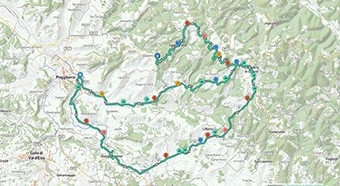
<iframe src="https://plugin.routeyou.com/poiviewer/free/?language=en&params.poi.id=3163573" width="100%" height="600" frameborder="0" allowfullscreen></iframe>

More than 11,800,000 routes

More than 15,000,000 users

More than 4,500,000 points of interest

Kerkstraat 108
9050 Gentbrugge, Belgium
© 2006-2026 RouteYou - www.routeyou.com