The Hohnbach, or Lontzenerbach, is a small stream in the Herve region whose valley, between Lontzen and La Calamine, is of great interest in terms of landscape, ecology, and biology. The site was well studied from a phytosociological perspective during the 1970s and 1980s. The forested areas are particularly remarkable and include a ash-alder forest with starwort housing splendid specimens of the rare smooth elm (Ulmus laevis), an alluvial alder stand with garden thistle (Cirsium oleraceum), a rich riverside ash forest with sedges (Carex spp.), a magnificent calcareous oak-hornbeam forest with cowslip (Primula veris) and early purple orchid (Orchis mascula), where also grows the rather uncommon numerous-rooted sedge (Carex umbrosa), a neutral oak-hornbeam forest locally well-populated by wild garlic (Allium ursinum), or a siliceous oak forest with birches (Betula spp.) where wood fescue (Festuca altissima) appears locally. The banks of the stream are populated by a rich and varied flora, including panicled sedge (Carex paniculata), bistort (Persicaria bistorta), water avens (Geum rivale), and marsh hawkbit (Crepis paludosa). The valley also features meadowsweet megafauna (Filipendula ulmaria), magnocaricetums, and springs with Pyrenean cochlearia (Cochlearia pyrenaica), which is the only known location in Belgium. Very locally, some fragments of calcareous grassland and even a few rocky outcrops with blue sesleria (Sesleria caerulea) are found. To all these very contrasting groupings of high heritage value, there is also added, at the place called "Schmalgraf", a calamine dump consisting of an oligotrophic meadow element with molinia (Molinia caerulea), succisa (Succisa pratensis), and tormentil (Potentilla erecta), and a meadow with metallophytes characterized by Westphalian fescue (Festuca ovina subsp. guestfalica), calamine violet (Viola calaminaria), calamine campion (Silene vulgaris subsp. vulgaris var. humilis), and calamine pennycress (Thlaspi caerulescens subsp. calaminare). The local fauna is very rich, particularly counting 30 species of butterflies, including the lesser purple emperor (Issoria lathonia), which develops at the expense of calamine violet, and at least ten species of bats that visit the area both in summer and winter, where they take refuge in two former calamine mines. The Hohnbach valley is almost entirely integrated into the Natura 2000 network, and about 18 hectares, owned by the Walloon Region, have benefited from the status of a state natural reserve since 2016.
Public Access: No hunting or fishing. Access limited to paths.
Type: Site of Great Biological Interest (SGIB)
 | | Public | Danish • Dutch • French • German • Italian • Spanish

Select one of the most popular activities below or refine your search.
Discover the most beautiful and popular trails in the area, carefully bundled into appropriate selections.
Source: Wikimedia
Select one of the most popular categories below or be inspired by our selections.
Discover the most beautiful and popular attractions in the area, carefully bundled in appropriate selections.
Source: Wikimedia
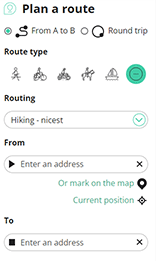
With RouteYou, it's easy to create your own customised maps. Simply plot your route, add waypoints or nodes, add places of interest and places to eat and drink, and then easily share it with your family and friends.
Route planner
<iframe src="https://plugin.routeyou.com/poiviewer/free/?language=en&params.poi.id=7304031" width="100%" height="600" frameborder="0" allowfullscreen></iframe>

More than 11,800,000 routes

More than 15,000,000 users

More than 4,500,000 points of interest

Kerkstraat 108
9050 Gentbrugge, Belgium
© 2006-2026 RouteYou - www.routeyou.com