Art Deco villa built in 1935 with a garden of 70 ares; Various trees and shrubs from the original construction.
The conversion in 1911 of the Keulens Hof in Keerbergen into a 'hôtel-laiterie' is probably the very beginning of residential tourism, which developed especially during the interwar period in the drifting sand area between Bonheiden and Tremelo. Dune soils, preferably with pine trees, were the most popular. The holidaymakers and owners of country and (later) permanent residences were mainly from the Brussels agglomeration, in this case an "industrialist" from Anderlecht. The allotment and construction of the Hondsdonk in 1935, in the west of Tremelo, comes quite late in this development, more than ten years after the first villas in Keerbergen. Yet it is remarkable how, despite elements typical of the time – in this case a watered-down art deco with rough plastered walls – there is a return to construction concepts that have roots in the 19th century.
This applies in the first place to the classification:
1° neatly separated vegetable garden, not walled but in the shadow of the 'service wing', in this case a garage under a gable roof with two (style-typical) polygonal shields;
2° the ornamental garden that extends largely in front of the villa, with trees on the edge of an open space, currently grassy but with traces of rose beds.
In a later phase, in addition to the 'service wing', an L-shaped stable wing will also be erected, presumably by the second owner, who acquires the property in 1956. The disposition of the buildings involuntarily evokes the archetype of high court and lower court.
The current range of trees is very varied and – like the buildings – probably covers two generations:
1° trees with a trunk circumference of 200 centimetres to 260 centimetres (measured at a height of approx. 150 cm), in particular silver lime (Tilia tomentosa) and brown beech (Fagus sylvatica 'Atropunicea');
2° trees with a circumference of less than 200 centimetres (measured at a height of approx. 150 cm) such as large-leaved lime (Tilia platyphyllos), red mongrel horse chestnut (Aesculus x carnea), blue atlas cedar (Cedrus atlantica 'Glauca'), tree of heaven (Ailanthus altissima) and American sweetgum (Liquidambar styraciflua).
Also typical of the interwar period is the closure of the plot: a low wall with tubes between square pilasters in also plastered masonry.
 Azure
Azure | | Public | Danish • Dutch • French • German • Italian • Spanish
Address: Honsdonkstraat 97, 3120 Tremelo, Vlaanderen
Statistics
Select one of the most popular activities below or refine your search.
Discover the most beautiful and popular trails in the area, carefully bundled into appropriate selections.
Select one of the most popular categories below or be inspired by our selections.
Discover the most beautiful and popular attractions in the area, carefully bundled in appropriate selections.
With RouteYou, it's easy to create your own customised maps. Simply plot your route, add waypoints or nodes, add places of interest and places to eat and drink, and then easily share it with your family and friends.
Route planner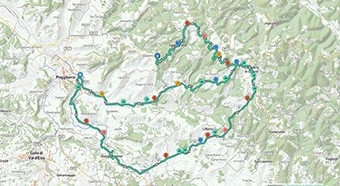
<iframe src="https://plugin.routeyou.com/poiviewer/free/?language=en&params.poi.id=7463609" width="100%" height="600" frameborder="0" allowfullscreen></iframe>

More than 11,800,000 routes

More than 15,000,000 users

More than 4,500,000 points of interest

Kerkstraat 108
9050 Gentbrugge, Belgium
© 2006-2026 RouteYou - www.routeyou.com