Source: Jan Rymenams
Papendel is a marshy nature reserve of 8.4 hectares. It consists of hay and reed fields, forests, and dense shrubbery. There is a long stretched pond and a large pond with adapted sloping edges, specially created for the amphibians. In the summer, hundreds of spotted orchids grow here, and you can also discover the broad-leaved wasp orchid.
On the Ferraris map, the area is indicated with the name Leusbosch and was designated as swamp forest. This condition dates back to the 16th century. Turf extraction has been documented since 1375. On old maps, the entire area of what would later become Begijnendijk and Pijpelheide was indicated as a ‘moor’. In the 15th century, the area was partitioned and converted into hay meadows and ‘eussels’. Agricultural development began in the 19th century along the Hannekensstraat. The area had various purposes: besides swamp forest, it was sometimes converted into hayland, sometimes planted with coppice, and exceptionally even with Scots pine.
The ponds around the area were created relatively recently as fishing ponds. The brook that drains the nature reserve is the Peuterstraatloop, which flows into the Vrouwvliet in Mechelen. This brook was already excavated in 1717 for better drainage of the area. That it was created by human hands is evidenced by its straight course.
Papendel can boast of being the habitat of the rare ‘brown fire butterfly’. This butterfly species was considered extinct for decades but has since been spotted again in the border area between Heist-op-den-Berg and Begijnendijk. Its habitat consists of poor to moderately nutrient-rich grasslands, rich in herbs and flowers. Especially field sorrel and sheep’s sorrel, common plants of poorer meadows, are interesting host plants for the caterpillars of the brown fire butterfly. The butterfly prefers sunny, warm, and sheltered spots bordered by hedgerows. Due to intensive management of the grasslands, this butterfly struggled, and thus Natuurpunt implemented suitable management of the grasslands. The mowing management is specifically done as sinus management. Most grass and hay lands are completely mowed, even in nature reserves. However, where phased sinus mowing management is applied, no more than 60 percent of the area is ever mowed. By mowing in alternating, sinus-shaped patterns, a maximum variation in habitats is created, with sections that skip a year or even several years to sections that are mowed several times per season. This way, there is something for every species at any time of the year, from nectar plants to overwintering sites.
Source: Jan Rymenams
 | | Public | Danish • Dutch • French • German • Italian • Spanish

Select one of the most popular activities below or refine your search.
Discover the most beautiful and popular trails in the area, carefully bundled into appropriate selections.
Source: Jan Rymenams
Select one of the most popular categories below or be inspired by our selections.
Discover the most beautiful and popular attractions in the area, carefully bundled in appropriate selections.
Source: Jan Rymenams
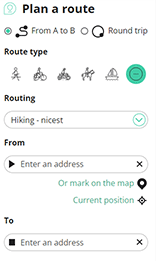
With RouteYou, it's easy to create your own customised maps. Simply plot your route, add waypoints or nodes, add places of interest and places to eat and drink, and then easily share it with your family and friends.
Route planner
<iframe src="https://plugin.routeyou.com/poiviewer/free/?language=en&params.poi.id=8268489" width="100%" height="600" frameborder="0" allowfullscreen></iframe>

More than 11,800,000 routes

More than 15,000,000 users

More than 4,500,000 points of interest

Kerkstraat 108
9050 Gentbrugge, Belgium
© 2006-2026 RouteYou - www.routeyou.com