The Bulgarian Greek Catholic Church , sometimes called, in reference to its Byzantine Rite, the Bulgarian Byzantine Catholic Church is a sui juris particular church in full communion with the Catholic Church and the Pope of Rome.Under Tsar Boris the Bulgarians accepted Christianity in its Byzantine form, with the liturgy celebrated in Church Slavonic. For a variety of reasons, Boris became interested in converting to Christianity and undertook to do that at the hands of western clergymen to be supplied by Louis the German in 863. However, late in the same year, the Byzantine Empire invaded Bulgaria during a period of famine and natural disasters. Taken by surprise, Boris was forced to sue for peace and agreed to convert to Christianity according to the eastern rites. His successor Symeon the Great proclaimed an autonomous Bulgarian Patriarchate in 917, which won recognition from Constantinople in 927 and lasted until the fall of the First Bulgarian Empire in 1018. In 1186 the Bulgarian state regained its independence. Pope Innocent III had written to tsar Kaloyan, inviting him to unite his church with the Catholic Church, as early as 1199. Wanting to bear the title of Emperor and to restore the prestige, wealth and size of the First Bulgarian Empire, Kaloyan responded in 1202. In this political maneuver, he requested that Pope Innocent III bestow on him the imperial crown. Kaloyan also wanted the Papacy to recognize the head of the Bulgarian Church as a Patriarch. The pope was not willing to make concessions on that scale, and when his envoy, Cardinal Leo, arrived in Bulgaria, he anointed the Archbishop Vasilij of Tărnovo as Primate of Bulgarians. Kaloyan only received Uniate crown, but not imperial. Meanwhile, in an attempt to foster an alliance with Kaloyan, the Byzantine Emperor Alexios III Angelos recognized his imperial title and promised him patriarchal recognition. In 1235 the Patriarch of Constantinople recognized the independence of the Bulgarian Church and the right of its leader to the patriarchal title. The Ottoman conquest of 1393 put an end to that patriarchate, whose territory was reunited with that of Constantinople. In the succeeding centuries the Bulgarian Church was gradually Hellenized: Greek was used in the liturgy, and the bishops were ethnic Greeks.
Source: Wikipedia.org
Copyright: Creative Commons 3.0

Select one of the most popular activities below or refine your search.
Discover the most beautiful and popular trails in the area, carefully bundled into appropriate selections.
Select one of the most popular categories below or be inspired by our selections.
Discover the most beautiful and popular attractions in the area, carefully bundled in appropriate selections.
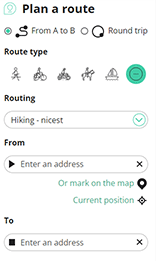
With RouteYou, it's easy to create your own customised maps. Simply plot your route, add waypoints or nodes, add places of interest and places to eat and drink, and then easily share it with your family and friends.
Route planner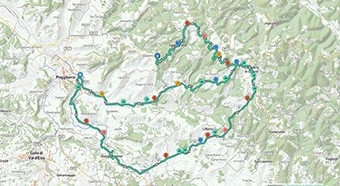
<iframe src="https://plugin.routeyou.com/poiviewer/free/?language=en&params.poi.id=8001177" width="100%" height="600" frameborder="0" allowfullscreen></iframe>

More than 11,800,000 routes

More than 15,000,000 users

More than 4,500,000 points of interest

Kerkstraat 108
9050 Gentbrugge, Belgium
© 2006-2026 RouteYou - www.routeyou.com



 | | Public |