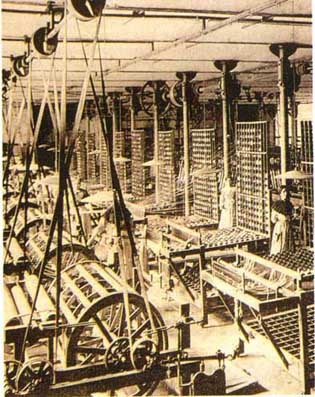
Industrial Looms.
Introduction:
Some streets, such as Igualada, Fraternitat (Fraternity) or Llibertat (Freedom), still preserve a few industrial workers' houses, which reflect the predominantly labourer and industrial identity of Gràcia. The lone chimney in Plaça del Poble Romaní (Romanian People's Square) reminds us of the history of the Vapor Nou, a textile factory which installed a steam engine to power their looms in 1839. The steam-powered textile industry arrived powerfully to Barcelona. And with it, labour movements also became firmly rooted.
Content:
Near the current C/Perill (
Danger Street), there was a factory run by Joan Vilaregut, one of Josep Bonaplata's partners. Bonaplata had introduced to Catalonia the first steam-powered textile machinery at his factory on C/Tallers, popularly called "
El Vapor" (The Steam Engine). In 1835, amidst a climate of widespread riots and the burning of convents, crowds set fire to Bonaplata's factory, attributing to the new machines the guilt for unfair competition. The first steam engines also arrived to Vilaregut's factory, which became known as the "Vapor de Gràcia" and, later, "
Vapor Vell" (Old Steam Engine). "Old" because in the year 1839, Francesc Puigmartí, who had a handicraft factory in the village, decided to also acquire a German steam engine, which came to be known as "
Vapor Nou" (New Steam Engine). This factory grew to employ five hundred workers. These two factories, in addition to the many artisanal looms that still operated throughout the town, made Gràcia one of the most important textile centres in Catalonia. Other local industries included typography and the production of matches, which could not be made within the walls of the city for being too dangerous. Workers' housing on C/Fraternitat, C/Llibertat and C/Igualada were built up as these factories grew and had to accommodate more and more workers. In theory, they were built for single-family use, but they were often simultaneously inhabited by several. These houses only had a ground floor, undecorated, with gas lighting and water from wells or from a roof tank which collected rainwater. The vindictive spirit of the village grew as well as these industries. In 1840, the Barcelona Weavers Association was founded in the city; it was the first workers' association in Catalonia, with many workers from Gràcia as members. In the late 19th and early 20th centuries, factories began leaving Gràcia in order to get farther away from Barcelona.
More Information:
Laia Mestre "La huella del siglo XIX en la plaza del poble romaní" El Periódico, 5 de setembre 2012. [in Spanish]
 | | Public