The monastery was founded in Puerta de Trina in 1472 and moved to Calle San José in the Jewish Quarter in 1493 with the help of the Catholic Queen Isabella, who gave her several houses, including a synagogue, which had been confiscated from the Jews. It was one of the first monasteries founded in Seville from the time of the Catholic Monarchs.
It was later expanded with the construction of the church in the 16th century, thanks to the support of Philip III and noble families of the city, such as Hernán Cortes and Captain Andrés Berdome, the latter of whom donated urban and rural estates that yielded high rents.
In 2022 the church underwent a major restoration.
As an additional activity, the congregation devotes itself to the production of handmade paper and fabric flowers and sweets.
It is open every Thursday morning all year round.
Sister Bárbara de Santo Domingo , a nun of this monastery who died in 1872, called "daughter of the Giralda" in the process of canonization , was born here in 1842 and lived there as the daughter of the bell ringer, a mystic with a reputation for holiness during her lifetime. The monastery preserves her cell and several mementos, buried under the lower choir. In the monastery there is the Spirituality Hall in her honor.
The long facade on San José Street has a wall where the main door from the 16th century, the work of Juan de Oviedo, is located. Here we see the coats of arms of the Catholic monarchs and symbols of the Dominican Order, as well as a relief of the Virgin giving the rosary to Saint Dominic, with the Eternal Father in the attic.
On the right, a marble plaque commemorates the history of the monastery.
The spectacular church is one of the largest monasteries in Seville, recently restored and air-conditioned.
The main chapel It has a beautiful octagonal dome covered with a Mudejar coffered ceiling, and is separated from the nave by a spectacular high main arch, highly decorated, like the walls.
At its base are two crypts , the work of Juan de Oviedo and Miguel Adán, where Catalina Zúñiga, widow of Hernán Cortés, patron of the main chapel, and her daughters Catalina and Juana, the latter of whom was prioress, are buried under recumbent statues and covered by an arcosolium.
The main altarpiece , originally Renaissance, is now a beautiful Baroque work by Francisco Barahona, 17th century, decorated with four Solomonic columns, the statues are by Jerónimo Hernández, 16th century.
It is preceded by the seated statue of the Virgin of the Rosary, also known as the Mother of God of Mercy, from the 16th century, with on its sides the statues of Saint Joseph and Saint Elisabeth, below her the relief of the Lord's Supper , and on the sides of this ensemble the statues of Saint Peter, Saint Andrew, Saint Thomas Aquinas and Saint Vincent Ferrer.
Source: Willem Vandenameele
 | | Public | Catalan • Danish • Dutch • French • German • Italian • Spanish

Select one of the most popular activities below or refine your search.
Discover the most beautiful and popular trails in the area, carefully bundled into appropriate selections.
Source: visitarsevilla
Select one of the most popular categories below or be inspired by our selections.
Discover the most beautiful and popular attractions in the area, carefully bundled in appropriate selections.
Source: visitarsevilla
With RouteYou, it's easy to create your own customised maps. Simply plot your route, add waypoints or nodes, add places of interest and places to eat and drink, and then easily share it with your family and friends.
Route planner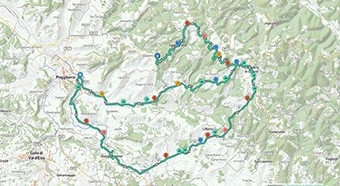

<iframe src="https://plugin.routeyou.com/poiviewer/free/?language=en&params.poi.id=8743467" width="100%" height="600" frameborder="0" allowfullscreen></iframe>

More than 11,800,000 routes

More than 15,000,000 users

More than 4,500,000 points of interest

Kerkstraat 108
9050 Gentbrugge, Belgium
© 2006-2026 RouteYou - www.routeyou.com