Haut-Kœnigsbourg Castle is located near Orschwiller in Alsace, about ten kilometers west of Sélestat. The fortress is situated on a ridge of the eastern Vosges at an altitude of 755 m above the Rhine valley.
The fortress was the center of the lordship of Kœnigsbourg, which also included the village of Orschwiller. Until 1648, the lordship was part of the County of Habsburg.
The castle was first mentioned in the 12th century. Its strategic importance was recognized by the Duke of Swabia, Frederick of Hohenstaufen. The castle was built around 1147 as Schloss Staufen or also known as Castrum Estufin by the dukes of Lorraine. The owners of the castle controlled the villages and trade routes in this part of the Rhine valley due to its strategic position. The location of the castle is at a crossing of trade routes for grain and wine (north-south) and silver and salt (west-east). From 1192, the name Königsburg was used. In 1359, the Hohenstaufen family sold the castle to the Prince-Bishopric of Strasbourg. In 1454, Elector Frederick I of the Palatinate captured the castle as regent of Alsace. In 1479, the castle and the lordship were granted as an Austrian fief by Emperor Frederick III to the Swiss Count Oswald von Thierstein and his brother Wilhelm. After the extinction of the von Thierstein family in 1517, the fief reverted to Austria.
On January 29, 1533, the lordship was pledged to Schweighard Jan and Frans Koenraad of Sickingen. The pledge subsequently came to the barons of Bollwiller in 1605 and then to the Fugger family in 1617.
During the Thirty Years' War, the fortress was besieged by the Swedes for 52 days and eventually captured and set on fire on September 7, 1633.
Due to the Peace of Münster in 1648, the lordship was lost to the Holy Roman Empire and Habsburg and became part of France.
Between 1648 and 1865, the ruin had several owners until it eventually came into the possession of the French state.
After the Franco-German War, Alsace-Lorraine became part of the German Empire in 1871, and the town of Schlettstadt/Sélestat donated the castle to German Emperor Wilhelm II on May 4, 1899. The emperor saw the castle as a symbol of Alsace's Germanic past and wanted to make it a symbol of the resurrected German empire. It was intended to establish a museum for the Middle Ages in the castle. The emperor had the castle reconstructed by the Berlin architect Bodo Ebhardt (1902-1908). With the peace of Versailles, the castle came back into the hands of the French state.
Today, the castle is considered one of the best-preserved fortresses and is the only French Monument national located in Alsace. Its impressive bastion, the keep, the Logis Seigneurial, and the view over the Rhine valley, as well as the sight of nearby ruins of other castles (e.g., Ortenbourg, Ramstein), have made the castle a popular tourist attraction.
 | | Publiek | Deens • Duits • Frans • Italiaans • Nederlands • Spaans
Adres: Alsace, Frankrijk
Statistieken
Selecteer hieronder één van de populairste activiteiten of verfijn je zoekopdracht.
Ontdek de mooiste en meest populaire routes in de buurt, zorgvuldig gebundeld in passende selecties.
Selecteer hieronder één van de populairste categorieën of laat je inspireren door onze selecties.
Ontdek de mooiste en meest populaire bezienswaardigheden in de buurt, zorgvuldig gebundeld in passende selecties.
Met RouteYou kan je eenvoudig zelf aangepaste kaarten maken. Stippel je route uit, voeg waypoints of knooppunten toe, plan bezienswaardigheden en eet- en drinkgelegenheden in en deel alles met je familie en vrienden.
Routeplanner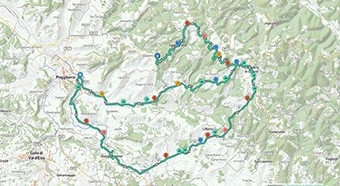
<iframe src="https://plugin.routeyou.com/poiviewer/free/?language=nl&params.poi.id=2557309&params.language=en" width="100%" height="600" frameborder="0" allowfullscreen></iframe>

Meer dan 11.800.000 routes

Meer dan 15.000.000 gebruikers

Meer dan 4.500.000 trekpleisters

Kerkstraat 108
9050 Gentbrugge, België
Neem contact op met ons klantenserviceteam of bezoek ons helpcentrum.
© 2006-2026 RouteYou - www.routeyou.com