Source: © Tourisme Grand Verdun / Marie JACQUINET
Copyright: All rights reserved


Due to ash chalarosis (a disease caused by a microscopic parasitic fungus), certain trees and branches in the Forêt d?Exception® de Verdun are weakened and present a risk of falling. For safety reasons, this site should be avoided. For further information, visit www.tourisme-verdun.com
Founded in the Gallo-Roman era (2nd century A.D.), the village of Louvemont lived mainly from agriculture.
The first church was built in the 11th century.
It was replaced in the 17th century by the construction of the choir of a new church, whose nave and bell tower were erected in 1778.
With 300 inhabitants in 1846, by 1914 the population had dwindled to just 183, living mainly from farming.
In August 1914, the front line was some 6 or 7 km from the village. As a result, civilian traffic was very limited. Then, in October 1914, the French army pushed the village further away from the danger of sporadic German artillery fire.
On February 21, 1916, at the start of the great German offensive, Louvemont came under heavy bombardment. Until the evening of February 25, its defenders withstood the noise and terrible destruction caused by the shells, then bayoneted the German infantrymen.
From late February to mid-December 1916, the fiercest fighting took place on the côte du Poivre, stretching from Louvemont to Vacherauville.
Finally, on December 15 and 16, 1916, the Germans abandoned the sector following General Mangin?s victorious offensive.
The ruins of Louvemont reverted to French rule for the rest of the war.
Classified as a "red zone", Louvemont was declared a destroyed village in 1919, benefiting from this unique status which enabled it to build, between the two wars, its war memorial and the Saint-Pierre aux liens chapel-shelter, inaugurated on May 3, 1930.
The inscription "En souvenir de Haudraumont et de Mormont" (In memory of Haudraumont and Mormont) on the monument recalls the vanished existence of two small hamlets in the commune.
Similarly, the addition of "Côte du Poivre" to its own name testifies to the determination of its former inhabitants never to erase from their memory this high point in the tragic history of the 1914-1918 war and of their commune.
What to see
- The chapel
-saint-Pierre aux liens shelter ;
- The war memorial;
- Remains of the old cemetery;
- The reconstructed fountain and the stones and rows of trees marking the streets and the town hall-school.
Source: OT GRAND VERDUN
Copyright: Creative Commons CC BY 2.0
Address: 55100 Louvemont-Côte-du-Poivre
Statistics
Select one of the most popular activities below or refine your search.
Discover the most beautiful and popular trails in the area, carefully bundled into appropriate selections.
Source: © Tourisme Grand Verdun / Marie JACQUINET
Copyright: All rights reserved
Select one of the most popular categories below or be inspired by our selections.
Discover the most beautiful and popular attractions in the area, carefully bundled in appropriate selections.
Source: © Tourisme Grand Verdun / Marie JACQUINET
Copyright: All rights reserved
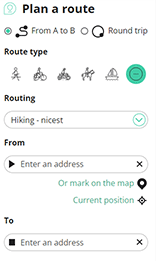
With RouteYou, it's easy to create your own customised maps. Simply plot your route, add waypoints or nodes, add places of interest and places to eat and drink, and then easily share it with your family and friends.
Route planner
<iframe src="https://plugin.routeyou.com/poiviewer/free/?language=en&params.poi.id=8924370" width="100%" height="600" frameborder="0" allowfullscreen></iframe>

More than 11,800,000 routes

More than 15,000,000 users

More than 4,500,000 points of interest

Kerkstraat 108
9050 Gentbrugge, Belgium
© 2006-2026 RouteYou - www.routeyou.com



 | | Public |