Jan van Eyck is said to have been an active alchemist. He was the inventor of a new type of oil paint that he developed around 1410. His paintings would frequently reference alchemy. In his self-portrait "Man with a Turban," which hangs in the National Gallery in London, the turban symbolizes the Philosopher's Stone. Also in his world-famous painting "Portrait of G. Arnolfini and Giovanna Cenami" from 1434, also in the National Gallery, the marriage would symbolize the link between sulfur and mercury. These were the basic ingredients for making gold according to alchemists. The Philosopher's Stone lies behind the couple but can be seen in the renowned convex mirror in the painting, which is rendered with masterful detail and accuracy.
His patron was Philip the Good, who also had a very strong interest in alchemy. This was even said to be the underlying reason for the founding of the Order of the Golden Fleece in 1429. Philip the Good even had a lab in his own palace.
 | | Public | Danish • Dutch • French • German • Italian • Spanish

Select one of the most popular activities below or refine your search.
Discover the most beautiful and popular trails in the area, carefully bundled into appropriate selections.
Source: http://www.ojodigital.com/f...
Select one of the most popular categories below or be inspired by our selections.
Discover the most beautiful and popular attractions in the area, carefully bundled in appropriate selections.
Source: http://www.ojodigital.com/f...
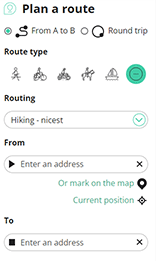
With RouteYou, it's easy to create your own customised maps. Simply plot your route, add waypoints or nodes, add places of interest and places to eat and drink, and then easily share it with your family and friends.
Route planner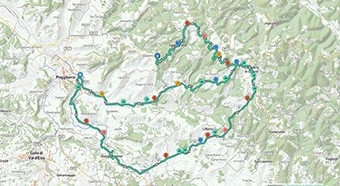
<iframe src="https://plugin.routeyou.com/poiviewer/free/?language=en&params.poi.id=1276190" width="100%" height="600" frameborder="0" allowfullscreen></iframe>

More than 11,800,000 routes

More than 15,000,000 users

More than 4,500,000 points of interest

Kerkstraat 108
9050 Gentbrugge, Belgium
© 2006-2026 RouteYou - www.routeyou.com