Risorsa: Willem Vandenameele
The Church of San Pietro in Camaiore was once part of a large Benedictine monastery founded along the Via Francigena. The first documented mention of the building dates back to 761. The fortunes of this monastery over time are mainly due to its location: the Via Francigena was in fact one of the main arteries of Italy, as it connected Rome with Canterbury ( England) alliance. Due to its height, it was often traveled by traders from all over the Mediterranean and Europe. This church was mainly located on the traffic axis between Lucca and Luni, rich cities and seats of dioceses. The abbey soon established itself in the area, mainly thanks to the remarkable donations it received, mainly recorded between 1000 and 1100. At the same time, the abbot's secular power also grew. The bull by which Pope Alexander III placed the monastery under his direct patronage and confirmed certain privileges, such as the ability to perform funeral rites, the collection of tithes, and the right to elect priests to minister to churches and chapels under the jurisdiction of the abbey fell, dating from April 28, 1180.
In 1217, the monks of the Order of the Flores, a monastic order founded by Joachim of Fiore at the end of the 12th century, appeared in Camaiore. The extension of the primitive church was also completed during the same period, which must have been about the size of the current church of San Michele. The new ground plan, which corresponds to the current one, added two naves, the apsidal part and the lower part of the facade. The entrance portal still has its original lunette, while the iambs have been replaced.
At the same time, the monastery was provided with a wall, of which only the entrance portal to the cemetery remains. On top of the arch there are still statues of the holy apostles Peter and Paul and an epigraph with probably the foundation date of the walls and the symbol of the Florian order. The monastery and the rest of the monastery were on the north side, on the south side was the cemetery (as it still is today). Only the refectory remains of the monastery. The interior of the church must also be frescoed, of which only two frescoes remain today, depicting Saint Mary of Egypt and Our Lady of Mercy, respectively on the first and second pillars at the entrance, probably painted by the school of Giotto and dating from the 14th century. It is almost certain that the rest of the church also had frescoes, but these were lost after the fire in May 1329 caused by the troops of Marco Visconti, the then lord of Lucca. From the 14th to the 16th century, the monastery came under various orders and commend abbots until 1527, when Clement VII dissolved the monastery and abbey and assigned all its possessions to the Ospedale di San Luca of Lucca.
Works of remarkable importance that belonged to the church, in addition to those still inside (including the tabernacle and the stove from the 15th century), are kept in the Museum of Sacred Art in Camaiore. A volute capital from the 14th century, which was found in the cemetery of Badia, is instead exhibited in the Museo Archeologico Civico.
Risorsa: Willem Vandenameele
 | | Pubblica | Danese • Francese • Italiano • Olandese • Spagnolo • Tedesco

Seleziona una delle attività più popolari qui sotto oppure affina la ricerca.
Scopri gli itinerari più belli e popolari della zona, accuratamente raggruppati in apposite selezioni.
Risorsa: Willem Vandenameele
Seleziona una delle categorie più popolari qui sotto o lasciati ispirare dalla nostra selezione.
Scopri i luoghi di interesse più belli e popolari della zona, accuratamente raggruppati in apposite selezioni.
Risorsa: Willem Vandenameele
Con RouteYou puoi creare facilmente mappe personalizzate. Traccia il tuo itinerario, aggiungi waypoint o nodi, luoghi di interesse e di ristoro, e condividi le mappe con la tua famiglia e i tuoi amici.
Pianificatore di itinerari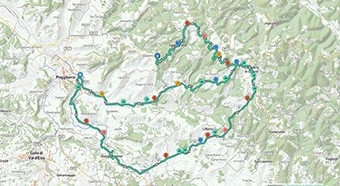
<iframe src="https://plugin.routeyou.com/poiviewer/free/?language=it&params.poi.id=8278937&params.language=en" width="100%" height="600" frameborder="0" allowfullscreen></iframe>

Più di 11.800.000 itinerari

Più di 15.000.000 utenti

Più di 4.500.000 luoghi d'interesse

Kerkstraat 108
9050 Gentbrugge, Belgio
© 2006-2026 RouteYou - www.routeyou.com