Source: GroeneHartstocht
In the thirteenth century, people in the Netherlands began to build with brick. Every landlord with some importance - including Zweder van Abcoude from the Van Zuylen family (hence the three columns in the city coat of arms of Wijk bij Duurstede) - wants a 'stone house'. In 1270 Zweder had the first brick building built on the spot where the old town of Dorestad was located. It concerns the Donjon, a defensible residential tower.
In the middle of the 15th century, the rule of the Van Abcoudes passed to the bishop of Utrecht. And Wijk bij Duurstede, a flourishing settlement in an earlier period, became important again in Europe. This had everything to do with the arrival of the Burgundian bishops. David, a bastard son of Philip the Good, was appointed the new bishop of Utrecht. But he could not go to Utrecht itself because gijsbrecht van Brederode, elected by the people, resided there as bishop. David therefore settled at Duurstede. But he found the single Donjon tower too poor and in no time had the entire island expanded into a large mighty castle, with the originally square tower in the middle. At that time, without outbuildings, it had seventy-five rooms.
After 1470, the castle was for many years the center of power, pageantry and splendor, of grand celebrations and promotion of art and culture. David spent forty years of his life there. He was succeeded by his half-brother Philips. This bishop died in 1524 and left his estate at Duurstede Castle to his successor. But he didn't feel like accepting the inheritance because he had to pay the huge debts. The entire estate was therefore auctioned.
After Emperor Charles V briefly owned the castle, it became the property of the States of Utrecht, which had no money for maintenance. The uninhabited castle quickly fell into disrepair and lost its stones. The French destroyed the inner city of Wijk bij Duurstede in 1672, but left the abandoned castle untouched.
In 1852, the city of Wijk bij Duurstede took ownership of the ruin and a city park was built around it. But on the castle island itself, the towers fell into worrying condition. In 1883 and 1948 restorations took place on the Burgundian tower. In 1986 it was the turn of the old square Donjon. The restoration was completed at the end of 2013. A lot of masonry has been restored, new natural stone has been installed and the tower crosses, the stained glass windows and the chimney have been restored. The castle has the status of national monument and is considered by experts to be one of the most beautiful medieval castles in the Netherlands.
 Azure
Azure | | Public | Danish • Dutch • French • German • Italian • Spanish

Select one of the most popular activities below or refine your search.
Discover the most beautiful and popular trails in the area, carefully bundled into appropriate selections.
Source: GroeneHartstocht
Select one of the most popular categories below or be inspired by our selections.
Discover the most beautiful and popular attractions in the area, carefully bundled in appropriate selections.
Source: GroeneHartstocht
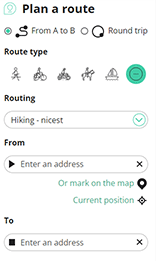
With RouteYou, it's easy to create your own customised maps. Simply plot your route, add waypoints or nodes, add places of interest and places to eat and drink, and then easily share it with your family and friends.
Route planner
<iframe src="https://plugin.routeyou.com/poiviewer/free/?language=en&params.poi.id=8169319" width="100%" height="600" frameborder="0" allowfullscreen></iframe>

More than 11,800,000 routes

More than 15,000,000 users

More than 4,500,000 points of interest

Kerkstraat 108
9050 Gentbrugge, Belgium
© 2006-2026 RouteYou - www.routeyou.com