Source: GroeneHartstocht
The name of the entity 'Benthusen' is first mentioned in documents in the 13th century. In 1282, Dirk van Teylingen was granted an area on loan around Waddinxveen by Floris V, Count of Holland. The borders of that area are indicated in the deed with a number of entities, including 'Benthusen'. The village must have originated before that time, likely in the tenth and eleventh centuries. During this period, the population rapidly increased and the vast peat wildernesses in this area were reclaimed. The toponym 'Benthuizen' is a composition of the ending '-huizen', which was a common designation for a residential area since the Carolingian period, and 'bent', which is another name for reed grass.
Under pressure from population growth, Dirk van Teylingen was tasked by Count Floris V to reclaim the vast peat wildernesses in this area, which involved lowering the water level, cutting down forests, constructing roads, and digging canals.
These reclaimed areas were then used for arable farming, livestock grazing, and cutting turf. The harvesting of turf from the peat soils in the surrounding areas was a significant source of income for the village's inhabitants for centuries, as is also reflected in the municipal coat of arms (the elongated blocks are turf briquettes). Initially, peat was harvested to the groundwater level, but demand for fuel in the cities was so great that in the 16th century, production switched to 'half-turf'. Special scoops were used to dredge until sea clay was reached, resulting in the formation of extensive water areas. As a result, the population of Benthuizen decreased. In 1632, Benthuizen had one hundred houses, while a hundred years later, in 1732, only 37 houses remained. This was a consequence of peat extraction. The hamlets of Benthorn and Hogeveen became depopulated due to this development and would later be added to the municipality of Benthuizen. The lordship of Benthuizen came into the possession of Jan van Beaumont in 1330 and through inheritance, it passed into the hands of various other lords over time. Successively in 1408 Jan van Heemsteden and Willem van Egmond, in 1495 Cornelis Croesinck, in 1595 Jacob (Oem) van Wijngaarden and several sons and a cousin, in 1690 Catharina van Zuijtland van Moermont. (some street names in the current village are named after these lords and ladies). The city of Rotterdam became the owner in 1692, purchasing the entity to create a navigable connection to the Oude Rijn. Rotterdam remained the lord of Benthuizen for 160 years. In 1759, with the cooperation of the respective lords, the city of Rotterdam for Benthuizen, Jacob Arent van Wassenaar for Hoogeveen, and Adam Arent van den Duijn for Benthorn, the flooded area was drained.
The reclaimed land proved very suitable for arable farming and livestock farming, and of course also a few craftsmen and shopkeepers. Farms were built and the inhabitants of Benthuizen gained more prosperity. The adjacent municipalities of Hoogeveen and Benthorn underwent the same fate of reclamation, peat extraction, depopulation, and reconstruction due to the drainage. Farms were also built there. After the reclamation of the large water masses, the population increased again, and the village acquired a strong agricultural character. Historically, these three municipalities had already been merged into one ecclesiastical municipality of Benthuizen. Under the French Empire, Benthuizen, Hoogeveen, Benthorn, and Hazerswoude were merged into one municipality. At the beginning of the French occupation in 1795, Benthuizen had only 213 inhabitants. On February 10, 1796, Benthuizen was reported as being 806 Morgen and 279 1/2 Roeden, thus about 650 hectares. However, at the beginning of the nineteenth century, Benthuizen was not larger than 695 Morgen (about 560 ha). This was a result of peat extraction.
In 1817, the old situation of independent municipalities was restored. In 1853, the remainder of the rights was transferred by Rotterdam to Otto Boudewijn’t Hoof in Dordrecht. Through inheritance, many estates and 7 farms came into the possession of the Beelaërts van Emmichhoven family. However, during the course of the nineteenth century, Hoogeveen and Benthorn were added to Benthuizen, creating the new municipality of Benthuizen. In 1899, the village had 645 predominantly Reformed inhabitants. Benthuizen has long remained a strongly agricultural municipality, with many artisanal businesses in the village. After World War II, agricultural operations changed rapidly, with less livestock farming and more crops. This agriculture mechanized faster than any other industry and provided work for fewer and fewer people. Farmworkers found employment in factories and construction. Furthermore, the village was expanded with new houses, where many 'outsiders' settled, who pursued other professions in the neighboring cities. Benthuizen residents also sought work elsewhere. Until 1991, Benthuizen was an independent municipality. In 1991, Benthuizen became part of the new municipality of Rijneveld, which was renamed Rijnwoude in 1993. In 2011, it was decided that the municipality of Rijnwoude would merge with Boskoop and Alphen aan den Rijn. Given the location of Benthuizen near Zoetermeer, it was decided to organize a referendum with the question of whether Benthuizen should be part of this new municipality or be annexed to Zoetermeer. Ultimately, 1,417 voters, or 70.29%, chose the new ABR municipality (which would later be called Alphen aan den Rijn) and 599 people, or 29.71%, chose Zoetermeer. Thus, since January 1, 2014, Benthuizen has been part of the merged municipality of Alphen aan den Rijn. In 2005, the construction of the HSL-Zuid began east of Benthuizen (the HSL-Zuid tunnel under the Groene Hart starts at Benthuizen) and the Bentwoud was created to the south/southeast of the village.
Source: Historische Kring Benthuizen
 | | Public | Danish • Dutch • French • German • Italian • Spanish

Select one of the most popular activities below or refine your search.
Discover the most beautiful and popular trails in the area, carefully bundled into appropriate selections.
Source: GroeneHartstocht
Select one of the most popular categories below or be inspired by our selections.
Discover the most beautiful and popular attractions in the area, carefully bundled in appropriate selections.
Source: GroeneHartstocht
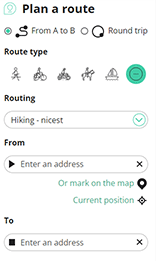
With RouteYou, it's easy to create your own customised maps. Simply plot your route, add waypoints or nodes, add places of interest and places to eat and drink, and then easily share it with your family and friends.
Route planner
<iframe src="https://plugin.routeyou.com/poiviewer/free/?language=en&params.poi.id=8159522" width="100%" height="600" frameborder="0" allowfullscreen></iframe>

More than 11,800,000 routes

More than 15,000,000 users

More than 4,500,000 points of interest

Kerkstraat 108
9050 Gentbrugge, Belgium
© 2006-2026 RouteYou - www.routeyou.com