Source: Groenehartstocht
The Baarnse Bos is more of a park than a forest. You can walk on wide beech avenues or follow winding paths.
In the forest you can find many cultural-historical elements such as the star forest, avenues of view, beautiful monumental trees, the berceau, the Grote Kom and the Kleine kom.
In 2012 a start was made with the restoration of a number of elements in the Baarnse Bos. The Grote Kom, the large pond in the middle of the star forest, has been completely renewed. After that, five elements were restored or strengthened: the entrance of the forest at De Generaal, the Lindenkom, the Berceau, the Ganzenvoet and the Troon. This renovation was completed in 2016.
The Baarnse Bos was probably laid out in the first half of the 18th century by Daniel Marot (1661-1752) as a park forest in French style: planned, generous but still clear. In the middle is the Big Bowl. At this central point there are eight long straight sight lanes, the sight lines of which were based, among other things, on the Sint Joriskerk in Amersfoort. A view lane was constructed to give the residents of an estate a wide view. One of the avenues used to lead to the disappeared country house De Eult. This house was built in the middle of the 17th century, about 10 years earlier than the house Soestdijk. Both estates belonged to the De Graeff family, a wealthy family with a lot of political influence.
A daughter married the also very famous Jan Bicker, mayor of Amsterdam, shipowner and merchant. He built the house De Eult in 1640, together with Hooge Vuursche (a predecessor of the current Hooge Vuursche Castle).
One of their children married Jan de Wit, who often stayed at De Eult. He became guardian of the orphan William III, but was pro-state and opposed the fact that William III became stadtholder. In the disastrous year of 1672, the struggle between statesmen and princes was so great that the De Wit brothers were murdered. William III became stadtholder after all. The De Graeff family probably tried to make peace with the Oranges by offering the House of Soestdijk to William III for sale. As a result, Soestdijk came into the possession of Orange.
When the Deutz family (descendants of the De Graeff family) ran into financial difficulties at De Eult in 1758 and offered the house for sale, De Eult also came into the possession of Orange.
The estate was bought for 31,900 guilders and the further plots for 8,000 guilders. The house was intended for the ten-year-old William V, who would house his shells, stones and minerals there. The house became increasingly in the shadow of Soestdijk. It was finally demolished in 1879. The Baarnse Bos therefore has a very interesting historical past.
 Azure
Azure | | Public | Danish • Dutch • French • German • Italian • Spanish

Select one of the most popular activities below or refine your search.
Discover the most beautiful and popular trails in the area, carefully bundled into appropriate selections.
Source: Groenehartstocht
Select one of the most popular categories below or be inspired by our selections.
Discover the most beautiful and popular attractions in the area, carefully bundled in appropriate selections.
Source: Groenehartstocht
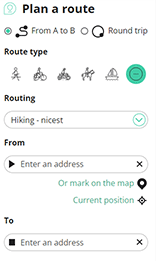
With RouteYou, it's easy to create your own customised maps. Simply plot your route, add waypoints or nodes, add places of interest and places to eat and drink, and then easily share it with your family and friends.
Route planner
<iframe src="https://plugin.routeyou.com/poiviewer/free/?language=en&params.poi.id=8176361" width="100%" height="600" frameborder="0" allowfullscreen></iframe>

More than 11,800,000 routes

More than 15,000,000 users

More than 4,500,000 points of interest

Kerkstraat 108
9050 Gentbrugge, Belgium
© 2006-2026 RouteYou - www.routeyou.com