In the Betuwe between the Waal and the Linge lies the municipality of Valburg. Ground traces of small houses, the walls of which consisted of willow weaving covered with clay, have revealed that the highest places, the so-called drakes, of the wild, often wet, not yet mined Betuwe must have been inhabited in the first centuries AD.
The Betuwe was then still covered with willows, ash and alders and intersected with innumerable streams and rivers, while along the embankments ran the heir roads of the Romans. In the seventh century, the names of the first settlements appear, such as Wulfura (Wolferen) in 673 and Falburc Marca (Valburg) in 793, followed later by Euwic Silec (Slijk-Ewijk) and Sethone (Zetten).
Valburg turned out to have been a marca of marke at that time. The marches were then small administrative communities of free farmers, who regulated and governed the use of the market lands. The main character was a boermarke chosen from among them, also called holtrichter. At their annual meetings (holtspraken) all inherited had the right to vote. The word marke originally meant only border. Later, however, this name came to apply to the land that lay within those borders. The marches have existed for a long time. Later, the lordships were added, which left their mark on this landscape. Then came the rear admirals, followed by the municipalities.
A few small municipalities, such as Loenen and Wolferen and the municipality of Hemmen, were later added to the municipality of Valburg, which is expressed in the current municipal coat of arms, which is divided into four sections (quarters). The coat of arms is covered with a golden crown of three leaves and two pearls. The coat of arms in section one is still carried by the Barons of Lawick. It shows a grafted silver crossbar on a red field.
In box two is the coat of arms of the municipality of Hemmen, which was dissolved in 1955. A typical coat of arms, which in the 'chessboard' gives an indication of the area and with the ermine box demonstrates the glorious authority.
The chessboard consists of 42 boxes, in the colors gold and blue (azure), with a free quarter of ermine in the upper right corner. Box three represents those parts that were never under the authority of Hemmen, Homoet or Loenen, but were directly controlled by Guelders. This is represented by the coat of arms of Guelders, from the period of the counts of Guelders from the house of Nassau. In azure a lion of gold, crowned with a golden crown, tongued and nailed of throat (red).
In section four, the high lordship of Loenen and Wolferen is represented in the form of the coat of arms of the lords of Gendt, who have long held sway over Loenen. It is a crossbar of throat (red), rattled with gold, on a silver field. About the old castle of Loenen is a legend known from the giant Knilles, read the legend here.
Source: Mijn Gelderland
 Azure
Azure | | Public | Danish • Dutch • French • German • Italian • Spanish

Select one of the most popular activities below or refine your search.
Discover the most beautiful and popular trails in the area, carefully bundled into appropriate selections.
Source: gemeentenieuws over-nederbetuwe
Select one of the most popular categories below or be inspired by our selections.
Discover the most beautiful and popular attractions in the area, carefully bundled in appropriate selections.
Source: gemeentenieuws over-nederbetuwe
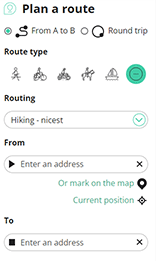
With RouteYou, it's easy to create your own customised maps. Simply plot your route, add waypoints or nodes, add places of interest and places to eat and drink, and then easily share it with your family and friends.
Route planner
<iframe src="https://plugin.routeyou.com/poiviewer/free/?language=en&params.poi.id=8265504" width="100%" height="600" frameborder="0" allowfullscreen></iframe>

More than 11,800,000 routes

More than 15,000,000 users

More than 4,500,000 points of interest

Kerkstraat 108
9050 Gentbrugge, Belgium
© 2006-2026 RouteYou - www.routeyou.com