The lock and weir complex at Driel in Gelderland is decisive for the freshwater management in the Northern Netherlands and the IJsselmeer region. The weir in the Lower Rhine also maintains the water level in the IJssel for shipping all year round. Without additional weirs, the Lower Rhine downstream, later called Lek, would 'empty'. But for the passage over the Lower Rhine and Lek, the water level must be controlled all year round. The realisation of the Amsterdam-Rhine Canal in 1952 only made its necessity clearer. This was realized between 1957 and 1972 with extensive weirs and locks. Modern weirs and locks near Amerongen and Hagestein make the Lower Rhine and Lek navigable even in summer. To prevent flooding, the weirs open when the Lower Rhine has to discharge a lot of water. On average, the lock gates are open 14 days a year. Locks have been built next to the weirs for shipping. Fish passages have been added for fish. The Lekdijk protects a large part of the central and western Netherlands against flooding.
Source: Rijkswaterstaat
 Azure
Azure | | Public | Danish • Dutch • French • German • Italian • Spanish

Select one of the most popular activities below or refine your search.
Discover the most beautiful and popular trails in the area, carefully bundled into appropriate selections.
Select one of the most popular categories below or be inspired by our selections.
Discover the most beautiful and popular attractions in the area, carefully bundled in appropriate selections.
With RouteYou, it's easy to create your own customised maps. Simply plot your route, add waypoints or nodes, add places of interest and places to eat and drink, and then easily share it with your family and friends.
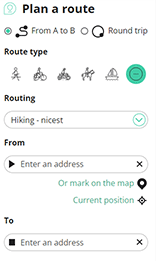
Route planner
<iframe src="https://plugin.routeyou.com/poiviewer/free/?language=en&params.poi.id=7472145" width="100%" height="600" frameborder="0" allowfullscreen></iframe>

More than 11,800,000 routes

More than 15,000,000 users

More than 4,500,000 points of interest

Kerkstraat 108
9050 Gentbrugge, Belgium
© 2006-2026 RouteYou - www.routeyou.com