Source: GroeneHartstocht


In 1741-1742 it was proposed that the then eighth flood defense would follow the course of the so-called Vudijck to the north of Amerfoort, the current Hoogerhorsterweg. The line dike and the Vudijk were indeed connected in 1745, and it was intended that the dike would actually be set up as a flood defense, complete with reinforcements.
Hornwork in the Line Dike
However, little came of this; the locals had the Vudijk partly excavated in the following decades to enable water drainage. When the Grebbelinie was flooded for the first time in 1794, the strip near Krachtwijk remained dry. In 1793, a report had already warned about this. It was decided to raise and relocate the Vudijk. Furthermore, the dike was to be positioned perpendicular to the Grebbeliniedijk, which happened in 1795-96.
Originally, there were plans to construct a outpost on the dike, similar to what would happen at Groeperkade, Asschatterkade, and Coelhorsterkade. Unfortunately, a wide area along the dike proved difficult to flood. This made the area too broad for a few cannons to cover with an outpost. Therefore, it was decided to create a fortification that was part of the retrenchment (the line dike). With the restored Vudijk, they could prevent the floodwater from flowing to the Zuiderzee. During the French period, the plans were realized. The work at Krachtwijk from 1799 now protected the Vuydijk and was also called Post aan de Vuydijk. In 1799, the line was also extended to connect to the Slaagse Dijk.
The work is still almost entirely present, although the contours in the landscape may not be noticeable to everyone. Especially from the air, these are clearly visible. The post consists of an embankment in the shape of an M, at the location where the Vuydijk connects to the Grebbelinie. In 1939, casemates were placed here, splinter-proof concrete shelters with three shooting holes, also known as Porcupines. There are two types on the embankment; an S3 casemate and two enlarged porcupines (Szw) for a heavy machine gun. The firing positions still cover the not flooded forecourt and give the peaceful dike a grim appearance that fits a fortification. Remnants of a cast steel dome and a second heavy casemate emphasize the location where the Grebbelinie transitions to the Eemdijk/Slaagse Dijk. At the intersection with the Vudijk, there are stone and concrete provisions. The Water Board can place stoplogs here during extremely high water, ensuring that the breach in the dike is closed.
Source: Wikipedia
 | | Public | Danish • Dutch • French • German • Italian • Spanish

Select one of the most popular activities below or refine your search.
Discover the most beautiful and popular trails in the area, carefully bundled into appropriate selections.
Source: GroeneHartstocht
Select one of the most popular categories below or be inspired by our selections.
Discover the most beautiful and popular attractions in the area, carefully bundled in appropriate selections.
Source: GroeneHartstocht
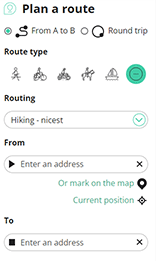
With RouteYou, it's easy to create your own customised maps. Simply plot your route, add waypoints or nodes, add places of interest and places to eat and drink, and then easily share it with your family and friends.
Route planner
<iframe src="https://plugin.routeyou.com/poiviewer/free/?language=en&params.poi.id=8566932" width="100%" height="600" frameborder="0" allowfullscreen></iframe>

More than 11,800,000 routes

More than 15,000,000 users

More than 4,500,000 points of interest

Kerkstraat 108
9050 Gentbrugge, Belgium
© 2006-2026 RouteYou - www.routeyou.com