Operation Claymore was the code name for a British commando raid on the Lofoten Islands in Norway during the Second World War. The Lofoten Islands were an important centre for the production of fish oil and glycerine, used in the German war economy. The landings were carried out on 4 March 1941, by the men of No. 3 Commando, No. 4 Commando, a Royal Engineers Section and 52 men from the Norwegian Independent Company 1. Supported by the 6th Destroyer Flotilla and two troop transports of the Royal Navy, the force made an unopposed landing and generally continued to meet no opposition. The original plan was to avoid contact with German forces and inflict the maximum of damage to German-controlled industry. They achieved their objective of destroying fish oil factories and some 3,600 t of oil and glycerine. The British experienced only one accident; an officer injuring himself with his own revolver and returned with some 228 German prisoners, 314 loyal Norwegian volunteers and a number of Quisling regime collaborators.
Through naval gunfire and demolition parties, 18,000 tons of shipping were sunk. Perhaps the most significant outcome of the raid was the capture of a set of rotor wheels for an Enigma cypher machine and its code books from the German armed trawler Krebs. German naval codes could be read at Bletchley Park, providing the intelligence needed to allow Allied convoys to avoid U-boat concentrations. In the aftermath, the evaluation of the operation differed, with the British, especially Winston Churchill and the Special Operations Executive, deeming it a success. In the eyes of the British the main value of such actions was to tie up large German forces on occupation duties in Norway. Martin Linge and the other Norwegians involved were more doubtful of the value of such raids against the Norwegian coast but were not told of the value of the seized cryptographic information. Following Operation Claymore, the Norwegian special operations unit Norwegian Independent Company 1 was established for operations in Norway.
Source: Wikipedia.org
Copyright: Creative Commons 3.0
 | | Public | Danish • Dutch • French • German • Italian • Spanish

Select one of the most popular activities below or refine your search.
Discover the most beautiful and popular trails in the area, carefully bundled into appropriate selections.
Select one of the most popular categories below or be inspired by our selections.
Discover the most beautiful and popular attractions in the area, carefully bundled in appropriate selections.
With RouteYou, it's easy to create your own customised maps. Simply plot your route, add waypoints or nodes, add places of interest and places to eat and drink, and then easily share it with your family and friends.
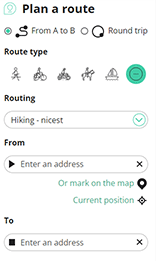
Route planner
<iframe src="https://plugin.routeyou.com/poiviewer/free/?language=en&params.poi.id=5765338" width="100%" height="600" frameborder="0" allowfullscreen></iframe>

More than 11,800,000 routes

More than 15,000,000 users

More than 4,500,000 points of interest

Kerkstraat 108
9050 Gentbrugge, Belgium
© 2006-2026 RouteYou - www.routeyou.com