Source: Willem Vandenameele


El pólder fue construido con un dique en 1510 por Philip van Kleef y originalmente se llamaba Groot-Breskenspolder.
En 1517, se fundó el pueblo de Breskens en la esquina sureste de este pólder. Cuando el Jong-Breskenspolder también se construyó un dique en 1527, el Groot-Breskenspolder pasó a llamarse gradualmente Oud-Breskenspolder. Su superficie es actualmente de 567 ha.
A partir de 2012, parte del pólder se convertirá en un área natural y recreativa llamada Waterdunen. El pólder se encuentra en NAP +1,5 m y, por lo tanto, está excavado con canales a una profundidad de NAP -2 m. El pólder agrícola fresco , que todavía es relativamente fresco a gran profundidad , se convertirá en un área de agua salada . El suelo se salinizará aún más. A partir de ahí , el agua subterránea más dulce será desplazada tierra adentro por agua más salada hasta cierto punto.
Source: Willem Vandenameele - Wikipedia
 | | Public | Catalan • Danish • Dutch • English • French • German • Italian

Select one of the most popular activities below or refine your search.
Discover the most beautiful and popular trails in the area, carefully bundled into appropriate selections.
Source: Willem Vandenameele
Select one of the most popular categories below or be inspired by our selections.
Discover the most beautiful and popular attractions in the area, carefully bundled in appropriate selections.
Source: Willem Vandenameele
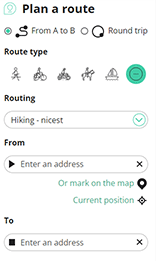
With RouteYou, it's easy to create your own customised maps. Simply plot your route, add waypoints or nodes, add places of interest and places to eat and drink, and then easily share it with your family and friends.
Route planner
<iframe src="https://plugin.routeyou.com/poiviewer/free/?language=en&params.poi.id=8611640&params.language=es" width="100%" height="600" frameborder="0" allowfullscreen></iframe>

More than 11,800,000 routes

More than 15,000,000 users

More than 4,500,000 points of interest

Kerkstraat 108
9050 Gentbrugge, Belgium
© 2006-2026 RouteYou - www.routeyou.com