Source: GroeneHartstocht
The “white church” at De Montignylaan 18 in Willige Langerak stood until 1943 in the center of the former municipality of Willige Langerak. Today, the church building, as a result of a border change in 1970 and later new construction in its vicinity, is integrated into the residential area Schoonhoven-Oost.
The oldest history of the church of Willige Langerak is largely shrouded in mystery. The first mention of a church at this location dates back to 1272. In the document from that year, in which the lord of Haastrecht and Vlist sells a drainage ditch to the lords of Langerak and Zevender, “the church at Langerack” is mentioned. Given the location of that ditch, it can only refer to the church of Willige Langerak and not that of Langerak on the opposite bank of the Lek. In 1291, old documents refer to Wilgerkercke, which presumably also refers to Willige Langerak.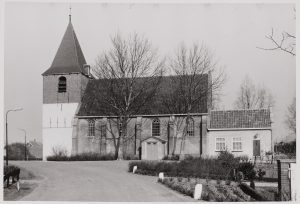
The oldest church is believed to have been built in the first half of the thirteenth century on an elevation in the landscape along the Lek. This makes sense: they wanted the church to remain dry and safe during high water from the Lek. The church fell under the ecclesiastical authority of the Chapter of Oudmunster, the administrators of the St. Salvator church in Utrecht. The provost of Oudmunster, who chaired that administration, had the right to appoint a pastor for the then obviously still Roman Catholic church of Willige Langerak. The parish of Willige Langerak extended over the eponymous reclamation, which was entirely located to the east; the western boundary was formed by the Zevender river. West of that lay Schoonhoven, which likely developed later than Willige Langerak. Between the Zevender and the church, until the end of the sixteenth century, there was an almost continuous building, and all the residents also attended church in Willige Langerak. The old Carmelite monastery of St. Michael in den Hem also belonged to the parish.
During the Eighty Years' War, the church likely suffered from the battles between the armies of the Spanish king and the Geuzen, who ultimately seized control of Schoonhoven and its surroundings in 1577. The church was likely largely lost in this process. It was not until 1627, about fifty years later, that work began on restoring the church tower, of which only the foundations of monastery bricks had survived. Church towers in most places in the Lopikerwaard were managed by the civil administration of the village in which they stood and were overseen by churchwardens appointed by the lord of the village. This was also the case in Willige Langerak. This explains why the first stone of the new tower was laid by a schepen, probably also a churchwarden: “Jan Jacobsz Uveren, take this to heart. Has laid the first stone of this tower. He was a man of great understanding, Schepen of this land. 1627.” The tower also served a defensive function: its walls are much thicker than those of the church building and it contains shooting holes. It is a square building in three sections.
The church section behind the tower was established only around 1650. Until then, there was likely no independent Reformed congregation in Willige Langerak, because after the Reformation, the adherents of the new doctrine were served by the pastor of Langerak across the Lek until 1651. Various places in the church hall, including on the pulpit and one of the gentlemen's benches, indicate the year 1650.
In the calamity year of 1672, Willige Langerak and its church faced serious hardship again. The church was heavily damaged once more; it was only in the first quarter of the eighteenth century that there was again money and materials available to restore the building to good condition. A significant renovation took place in 1836 and in 1893 the church was enlarged. In the 1930s, the roof of the church was renewed. Between 1977 and 1979, the tower was restored, and in 1990-1991, restoration and repair work was carried out on the church. Among other things, the severely deteriorated foundation was addressed.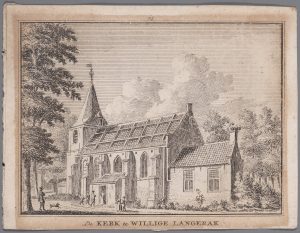
The interior of the church is simple, but it still has elements from the seventeenth century. The pulpit is located on the east side of the church, which can accommodate approximately 230 people. On the north side of the church is the “Gentlemen's bench,” where the lords of Willige Langerak and Zevender could sit when they were present in the village. The bench is also called the “Montigny bench,” named after the Le Fevre de Montigny family, who owned the lordship of Willige Langerak in the nineteenth century. The church organ was made in 1886 by the firm L van Dam & Sons from Leeuwarden and was placed in a front in neo-Renaissance style designed by the Schoonhoven architect J. Smits.
The Dutch Reformed church of Willige Langerak is a national monument. Since the seventeenth century, a minister's residence has belonged to the church, which was replaced by a new rectory in 1836. This rectory had to disappear in 1958 due to the widening of the old Kerklaan, now called De Montignylaan, and the current rectory was built.
Source: RHC Rijnstreek
 | | Public | Danish • Dutch • French • German • Italian • Spanish

Select one of the most popular activities below or refine your search.
Discover the most beautiful and popular trails in the area, carefully bundled into appropriate selections.
Source: GroeneHartstocht
Select one of the most popular categories below or be inspired by our selections.
Discover the most beautiful and popular attractions in the area, carefully bundled in appropriate selections.
Source: GroeneHartstocht
With RouteYou, it's easy to create your own customised maps. Simply plot your route, add waypoints or nodes, add places of interest and places to eat and drink, and then easily share it with your family and friends.
Route planner
<iframe src="https://plugin.routeyou.com/poiviewer/free/?language=en&params.poi.id=8176863" width="100%" height="600" frameborder="0" allowfullscreen></iframe>

More than 10,100,000 routes

More than 15,000,000 users

More than 4,500,000 points of interest

Kerkstraat 108
9050 Gentbrugge, Belgium
© 2006-2025 RouteYou - www.routeyou.com