Datenquelle: Willem Vandenameele


This statue is located at the Torre Guelfa near the ponte della Cittadella.
Galilei was born in Pisa on February 15, 1564, the eldest son of Vincenzo Galilei and Giulia Ammananti. [ His father was a well-known lute player-composer and author of music theory books. In 1572 Vincenzo with his wife and five youngest children moved to Florence, leaving eight-year-old Galileo in Pisa with Muzio Tedaldi, his mother's in-laws, a merchant with whom Galilei's father had briefly traded wool. In 1574, Galileo rejoined his family in Florence, where he was taught in the Camaldulen monastery of Santa Maria of Vallombrosa. The young Galileo was so drawn to monastic life that he was even a novice for a while, until his father took him away from there. He wanted his son to become a doctor, like a fifteenth-century ancestor of the Galilei family, Galileo Bonaiuti, after whom Galilei was named. The family struggled to make ends meet. Galileo provided for his brothers and sisters throughout his life.
In 1610, Galileo published his observations of the moon, the starry sky, the Milky Way, and the moons of Jupiter, all made using his telescope.
Beginning in 1612, there was opposition to Galileo's evidence for a Copernican, heliocentric worldview, which was inconsistent with the Church's view that the Earth was the center of the universe. Galileo went to Rome to defend himself. Cardinal Bellarmino, who was fond of Galileo, admonished Galileo by order of Pope Paul V in 1616 not to publicly defend the Copernican theory.
Before using the telescope for his astronomical observations, Galileo had demonstrated it to the Doge of Venice in August 1609 for war use. Contrary to what is still claimed, especially in Italy, Galileo had not invented the telescope: he found the Dutch binoculars on the market. This early type of telescope was invented around 1608 in Middelburg by Lippershey or Sacharias Jansen.
Galileo improved the telescope in 1609. For a long time it was thought that he was the first to use the telescope for astronomical observations, but that honor goes to Thomas Harriot
Datenquelle: Willem Vandenameele
 | | Öffentlich | Deutsch • Dänisch • Französisch • Italienisch • Niederländisch • Spanisch

Wählen Sie eine der beliebtesten Aktivitäten unten aus oder verfeinern Sie Ihre Suche.
Entdecken Sie die schönsten und beliebtesten Routen in der Gegend, sorgfältig gebündelt in einer passenden Auswahl.
Datenquelle: Willem Vandenameele
Wählen Sie eine der unten aufgeführten beliebtesten Kategorien oder lassen Sie sich von unserer Auswahl inspirieren.
Entdecken Sie die schönsten und beliebtesten Sehenswürdigkeiten der Gegend, sorgfältig gebündelt in einer entsprechenden Auswahl.
Datenquelle: Willem Vandenameele
Mit RouteYou kannst du ganz einfach eigene Karten erstellen. Plane deine Route, füge Wegpunkte oder Knotenpunkte hinzu, plane Sehenswürdigkeiten und Einkehrmöglichkeiten ein und teile alles mit Familie und Freunden.
Routenplaner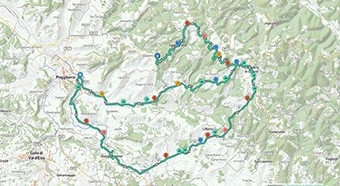
<iframe src="https://plugin.routeyou.com/poiviewer/free/?language=de&params.poi.id=8278658&params.language=en" width="100%" height="600" frameborder="0" allowfullscreen></iframe>

Mehr als 11.800.000 Routen

Mehr als 15.000.000 Benutzer

Mehr als 4.500.000 Sehenswürdigkeiten

Kerkstraat 108
9050 Gentbrugge,Belgien
© 2006-2026 RouteYou - www.routeyou.com