Source: Vlaamse Gemeenschap, 01-01-1987, ©Vlaamse Gemeenschap
Copyright: All rights reserved


In 1603, Mayor Nicolaas Rockox (1560-1640) bought the house known as "Sint-Jacob", also called "Den Gulden Rinck" (number 10) and the adjoining house (number 12) and rebuilt both properties into a single entity in Renaissance style. In 1714, the house was sold and partially renovated. This is referenced by the year 1715 on the pediment of number 10. Restoration works took place from 1916-1919 commissioned by the Reverend Mr. Cl. Ulens: architect Jules Bilmeyer built the gallery with corner tower in the large inner courtyard in 1916. His son, architect Edouard Bilmeyer, restored the facade of number 10 in 1919, adding the gate in Baroque style. A thorough restoration occurred from 1972-1977 under the direction of architects Joseph Louis Stynen and Richard De Bruyn, commissioned by the Kredietbank, which had rejected the property in 1970. Since then, it has been the Rockox House museum. A patrician residence with nine bays and two building levels, with a natural stone facade (number 10) on the right and a brick and sandstone facade (number 12) on the left. Number 10. Five bays and two building levels under a gabled roof with side gables of ten and nine steps, raised with a late Baroque dormer window between the wings under a triangular pediment - with the year 1715 in a cartouche - crowned with a gilded weather vane. Anchored sandstone facade with rectangular basement mouths, scaffolding holes, and a hollow rounded eave; adapted rectangular windows under a wedge-shaped relieving system (preserved on the upper floor) on the ground floor with bars and on the upper floor with continuous profiled lower sills. A hardstone portal was installed following the facade restoration by Edouard Bilmeyer in 1919, replacing a late-classical gate from around 1800. The portal is inspired by that of the beguinage in Diest: wooden round-arched door with a sculpted broker in a fluted round arch on block pilasters with lion heads and Ionic capitals; cartouche key with inscription: "In this house / lived / NIC. ROCKOX / Mayor / of this city / 1603-1640". Spandrels with volutes and moulding, heavy entablature under a corniced water table with volutes and top vases, and in the center, a richly framed round-arched niche containing a depiction of Our Lady of the Seven Sorrows by E. Declercq from 1921, made of German sandstone.
Source: Manderyck, Madeleine; Plomteux, Greet & Steyaert, Rita (1979)
Copyright: All rights reserved
 | | Public | Danish • Dutch • French • German • Italian • Spanish
Address: Keizerstraat 10, Antwerpen
Statistics
Select one of the most popular activities below or refine your search.
Discover the most beautiful and popular trails in the area, carefully bundled into appropriate selections.
Source: Vlaamse Gemeenschap, 01-01-1987, ©Vlaamse Gemeenschap
Copyright: All rights reserved
Select one of the most popular categories below or be inspired by our selections.
Discover the most beautiful and popular attractions in the area, carefully bundled in appropriate selections.
Source: Vlaamse Gemeenschap, 01-01-1987, ©Vlaamse Gemeenschap
Copyright: All rights reserved
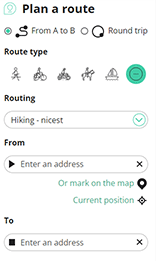
With RouteYou, it's easy to create your own customised maps. Simply plot your route, add waypoints or nodes, add places of interest and places to eat and drink, and then easily share it with your family and friends.
Route planner
<iframe src="https://plugin.routeyou.com/poiviewer/free/?language=en&params.poi.id=3179600" width="100%" height="600" frameborder="0" allowfullscreen></iframe>

More than 11,800,000 routes

More than 15,000,000 users

More than 4,500,000 points of interest

Kerkstraat 108
9050 Gentbrugge, Belgium
© 2006-2026 RouteYou - www.routeyou.com