Source: Van Harte Eijsden Margraten


Saint Brigid Church, Noorbeek (Roman Catholic)
The church is a three-nave basilica, started in Romanesque style but rebuilt in stages in Gothic style. It is one of the few village churches in South Limburg where some of the medieval atmosphere has been preserved and which has retained its main forms from the 15th century.
The oldest church must have already risen around the year 1000 on an artificial hill. The lower part of the tower still contains the uncut natural stone of this oldest church (11th/12th century). Perhaps this tower was also intended as a watchtower, where villagers could retreat in times of danger. In the 13th century, a Romanesque church in marl was built, of which the light openings and bell openings of the tower and five blind Romanesque round-arched windows in the nave still testify. Around 1400, the renovation began in stages into a Gothic church with pointed arches. During a renovation in the 16th century, the net vaults were introduced. In 1847 (see the stained glass above the entrance door), the entrance portal and the side spaces (current exhibition space) were built in brick. The builder was Pastor Clercks, whose grave (name without the 2nd c) is located 5 meters to the right of the large cross. Under Pastor Eygelshoven, a complete restoration took place from 1903 to 1913 (architect Sprenger), during which the sacristy and side sacristy were built on the north and south sides of the choir. It should be noted that the period from 1903-1910 was mainly used for planning, design, and fundraising. The actual restoration lasted from 1910 to 1913. In 1990-1991, another comprehensive consolidating restoration took place under Pastor Sax, with the cooperation of the National Heritage Service.
According to the parish archive, the Brigid Church was until 1614 a filial church of the parish church in 's-Gravenvoeren (B). That church, which was again a separation from the church of Saint Martens-Voeren, was donated in 1083 by Conrad I of Luxembourg, lord of the land of Daehlem, to the O.L. Vrouwe-Munster of the city of Luxembourg. Originally, the parish also included Mheer, which was separated in 1626. From 1616 until the dissolution of the order in 1773, the Jesuits of Maastricht held the right of collation of the church and the tithe right, which they had taken over from the O.L. Vrouwe-Munster in Luxembourg. It is known that the church was looted in 1568 by soldiers of William of Orange.
Source: Van Harte Eijsden Margraten
 | | Public | Danish • Dutch • French • German • Italian • Spanish
Address: Pley 8, Noorbeek, Limburg, Netherlands
Statistics
Select one of the most popular activities below or refine your search.
Discover the most beautiful and popular trails in the area, carefully bundled into appropriate selections.
Source: Van Harte Eijsden Margraten
Select one of the most popular categories below or be inspired by our selections.
Discover the most beautiful and popular attractions in the area, carefully bundled in appropriate selections.
Source: Van Harte Eijsden Margraten
With RouteYou, it's easy to create your own customised maps. Simply plot your route, add waypoints or nodes, add places of interest and places to eat and drink, and then easily share it with your family and friends.
Route planner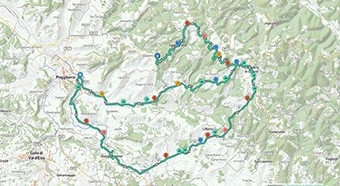

<iframe src="https://plugin.routeyou.com/poiviewer/free/?language=en&params.poi.id=2306405" width="100%" height="600" frameborder="0" allowfullscreen></iframe>

More than 10,100,000 routes

More than 15,000,000 users

More than 4,500,000 points of interest

Kerkstraat 108
9050 Gentbrugge, Belgium
© 2006-2025 RouteYou - www.routeyou.com